State Policy Updates Since the Release of the 2025 Roadmap
Our team releases the Prenatal-to-3 State Policy Roadmap each fall, which provides in-depth information and analyses on how state leaders took action to support children and families in the previous year. At the turn of each new year, many of those policies take effect or are automatically updated, leading to various changes to many of our Roadmap policies across states, including updates to state minimum wages, paid family and medical leave programs, state tax credits, child care subsidies, and doula policies.
This blog post outlines the state policy changes in effect since the release of our 2025 Roadmap, providing timely and up-to-date context for consideration as policy discussions continue in 2026.
At a Glance: State Policy Changes Since the 2025 Roadmap Release
19 States Increased Their Minimum Wage
A minimum wage establishes a floor for workers’ hourly wages to ensure a minimum level of compensation. Higher state minimum wages result in higher incomes, which can help families more easily access resources such as housing, food, health care, and transportation. Currently, state minimum wages range from the federal minimum of $7.25 in 20 states to $17.95 in the District of Columbia.
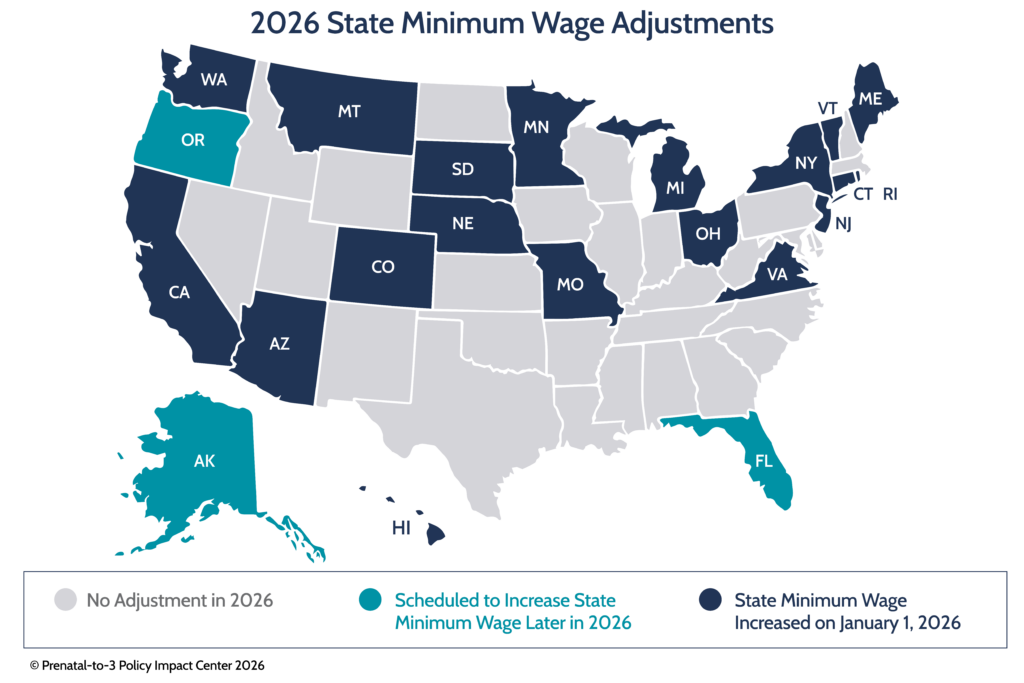
On January 1, 2026, state minimum wages increased in 19 states due to annual inflation adjustments or statutorily scheduled increases. Four additional states are scheduled to increase their minimum wage later in the year. Increases ranged from $0.28 per hour in Minnesota to $2.00 per hour in Hawaii. Arizona, Colorado, Hawaii, Maine, Missouri, and Nebraska all reached state minimum wages of $15.00 per hour or greater, with Florida set to join that group in September 2026.
2 States Newly Implemented Paid Family and Medical Leave Programs
State paid family and medical leave (PFML) programs provide working parents with the time and financial security needed to recover from childbirth, bond with a new child, and care for their families. Research shows that PFML programs that provide at least 12 weeks of paid leave for parents who give birth and 6 weeks for other parents improve outcomes related to workforce participation and health. Statewide PFML programs are designed to be self-sustaining, funded through small payroll contributions from workers, employers, or both.
Research shows that PFML programs increase mothers’ labor force participation, reduce infant mortality, improve parents’ mental health, and foster better child health.
On January 1, 2026, Delaware and Minnesota began implementing their PFML programs, bringing the total number of statewide programs to 12. Delaware’s program provides 12 weeks of bonding leave for all parents and Minnesota’s provides 18 to 20 weeks for parents who give birth and 12 for all other parents. Maine is set to implement a program of 12 weeks for all parents on May 1, 2026.
States Took Action on Family Tax Credits
State Earned Income Tax Credits
State earned income tax credits (EITCs) are supplements to the federal EITC, which is a refundable tax credit designed to incentivize work and help employees with low to moderate incomes keep more of their wages. State EITCs are a proven tool to increase household resources, reduce child poverty, improve parental employment, and improve birth outcomes. As of January 2026, 24 states—now including Pennsylvania—have fully implemented a refundable EITC of at least 10% of the federal EITC.
Pennsylvania enacted the Working Pennsylvanians Tax Credit through the state budget in November 2025. Families in Pennsylvania are now able to claim a refundable EITC worth 10% of the federal credit for tax year 2025.
The District of Columbia enacted legislation in December 2025 to increase its EITC from 85% to 100% of the federal credit for tax year 2025.
Montana will increase the value of the state EITC for families with children to 20% of the federal credit beginning in tax year 2026.
Oregon‘s state EITC will revert back to 11% of the federal credit for families with children under age 3—the value was temporarily expanded to 12% for tax years 2020-2025.
Colorado families will see a decrease in their state EITC in tax year 2026—from 50% to 25% of the federal credit—due to decreased revenue projections.
Pennsylvania
Pennsylvania enacted the Working Pennsylvanians Tax Credit through the state budget in November 2025. Families in Pennsylvania are now able to claim a refundable EITC worth 10% of the federal credit for tax year 2025.
District of Columbia
The District of Columbia enacted legislation in December 2025 to increase its EITC from 85% to 100% of the federal credit for tax year 2025.
Montana
Montana will increase the value of the state EITC for families with children to 20% of the federal credit beginning in tax year 2026.
Oregon
Oregon’s state EITC will revert back to 11% of the federal credit for families with children under age 3—the value was temporarily expanded to 12% for tax years 2020-2025.
Colorado
Colorado families will see a decrease in their state EITC in tax year 2026—from 50% to 25% of the federal credit—due to decreased revenue projections.
State Child Tax Credits
State child tax credits (CTCs) are designed to promote economic stability for families and reduce child poverty by offsetting some of the costs of raising children. State CTCs have become more widespread after the temporary expansion of the federal CTC in 2021, which lifted 2.1 million children out of poverty. Seventeen states have implemented a state CTC, inclusive of the newly effective credits in the District of Columbia and Georgia.
Next year, families in the District of Columbia will be able to claim a refundable CTC of $1,000 per child under 18, due to legislation enacted in December.
Georgia implemented a nonrefundable CTC of $250 per child under age 6 that families will be able to claim next year.
New York implemented a temporary CTC increase from $330 to $500 per child aged 4 to 17 for tax years 2026 and 2027.
Idaho’s nonrefundable credit expires this year, as the legislature did not take action to extend it. Families will no longer be able to claim the credit beginning next year.
Colorado’s Family Affordability Tax Credit (FATC) may not be available to families for tax year 2026. The availability and value of the FATC, along with the extended state EITC, can fluctuate based on fiscal year revenue projections. The annual revenue forecast released in December 2025 indicates that the FATC will not be available in tax year 2026.
District of Columbia
Next year, families in the District of Columbia will be able to claim a refundable CTC of $1,000 per child under 18, due to legislation enacted in December.
Georgia
Georgia implemented a nonrefundable CTC of $250 per child under age 6 that families will be able to claim next year.
New York
New York implemented a temporary CTC increase from $330 to $500 per child aged 4 to 17 for tax years 2026 and 2027.
Idaho
Idaho’s nonrefundable credit expires this year, as the legislature did not take action to extend it. Families will no longer be able to claim the credit beginning next year.
Colorado
Colorado’s Family Affordability Tax Credit (FATC) may not be available to families for tax year 2026. The availability and value of the FATC, along with the extended state EITC, can fluctuate based on fiscal year revenue projections. The annual revenue forecast released in December 2025 indicates that the FATC will not be available in tax year 2026.
Explore our Policy Impact Calculator to see how wages, paid leave, nutrition programs, child care subsidies, and tax credits shape the financial resources available to families with young children—state by state.
Several States Expanded Eligibility and Increased Rates for Child Care Subsidies
Child care subsidy programs help make child care more affordable for families with low incomes in which parents are working or enrolled in education or training programs. Subsidy programs are funded through a combination of federal and state dollars and states have considerable flexibility in implementation, including decisions around income eligibility limits, copayment levels, and provider reimbursement rates.
States have flexibility in how they implement their subsidy programs, including decisions around income eligibility limits, copayment levels, and provider reimbursement rates.
During the 2025 legislative session, six states enacted reimbursement rate increases through their budgets. Legislators in Alaska required the state to increase its income eligibility limit and reduce copayments effective January 2026. In late 2025, New Mexico made history by becoming the first state to offer no-cost, universal child care by removing income eligibility limits and waiving copayments for all families.
As of November 2025, several states had made updates to their subsidy programs administratively:
Five states made substantial income eligibility increases resulting in a higher income eligibility limit as a percentage of the state’s median income (SMI). 21 states updated their income eligibility as a dollar amount because their SMI increased.




Though several states updated their copayment schedules, the maximum copayment as a percentage of family income changed significantly in four states. Montana capped copayments for all eligible families at 7% of income and Virginia’s maximum copayment decreased from 6% to 5%. By contrast, Arkansas’ copayment increased from a maximum of 2% of family income to 12% and New Jersey’s maximum copayment increased from 5% to 7%.



Four states released a new Market Rate Survey (MRS) as of November 2025, reflecting increases to the price of child care across the board. Twelve states have updated their provider reimbursement rates, with 10 increasing rates for infants in center-based care. Of those states, Rhode Island and Idaho increased rates by the largest margin, both providing 20% increases. Two states, Arkansas and Indiana, decreased rates.
10 States Increasing Rates for Infants in Center-Based Care










Income Eligibility
Five states made substantial income eligibility increases resulting in a higher income eligibility limit as a percentage of the state’s median income (SMI). 21 states updated their income eligibility as a dollar amount because their SMI increased.
Copayment
Though several states updated their copayment schedules, the maximum copayment as a percentage of family income changed significantly in four states. Montana capped copayments for all eligible families at 7% of income and Virginia’s maximum copayment decreased from 6% to 5%. By contrast, Arkansas’ copayment increased from a maximum of 2% of family income to 12% and New Jersey’s maximum copayment increased from 5% to 7%.
Reimbursement Rates
Four states released a new Market Rate Survey (MRS) as of November 2025, reflecting increases to the price of child care across the board. Twelve states have updated their provider reimbursement rates, with 10 increasing rates for infants in center-based care. Of those states, Rhode Island and Idaho increased rates by the largest margin, both providing 20% increases. Two states, Arkansas and Indiana, decreased rates.
5 States Implemented Medicaid Reimbursement for Doulas
Community-based doulas provide non-clinical emotional, physical, and informational support to expectant parents throughout the perinatal period. Research shows that access to doulas can improve birth outcomes, enhance responsive parenting behaviors, improve access to perinatal care, and increase breastfeeding initiation.
As of January 2026, five states are scheduled to newly implement Medicaid reimbursement for doula services throughout this year, bringing the total number of states covering and reimbursing doulas through Medicaid to 31.



Utah’s state plan amendment was approved by the Centers for Medicaid and Medicare Services, and their doula Medicaid benefit will begin April 1, 2026, and coverage will include 8 hours of perinatal care and attendance at labor and delivery. Arkansas, Louisiana, Maine, and Montana were scheduled to implement coverage in January 2026, though it can take considerable time to set up a reimbursement program and to gain the necessary approvals from the federal government.
Follow State Action Throughout the Year
As the 2026 state legislative season is underway, we are continuing to track and summarize policy proposals that impact young children and families. For timely updates on what’s happening in state houses across the country, please subscribe to Legislative Trends and stay tuned for a comprehensive review of state action in our 2026 Prenatal-to-3 State Policy Roadmap, to be released this fall.