- Home
- /
- Research Topics
- /
- Governance
Governance
Across the US, state approaches to early childhood governance vary widely. Early childhood governance refers to the organization of government entities and the distribution of authority and accountability for administering programs and services that support young children and their families. State-level governance choices may affect families’ access to and experience with programs and services, as well as the efficiency of the system writ large. Use the buttons below to learn more about your state’s governance structure, how it compares to the national landscape, and lessons learned from our case studies on state governance.
Governance
Across the US, state approaches to early childhood governance vary widely. Early childhood governance refers to the organization of government entities and the distribution of authority and accountability for administering programs and services that support young children and their families. State-level governance choices may affect families’ access to and experience with programs and services, as well as the efficiency of the system writ large. Use the buttons below to learn more about your state’s governance structure, how it compares to the national landscape, and lessons learned from our case studies on state governance.
State Governance Structures
Each state’s early childhood system is uniquely organized. To better understand early childhood governance choices across the US, the Prenatal-to-3 Policy Impact Center at Vanderbilt University conducted a comprehensive landscape scan of all 50 states and the District of Columbia. The following charts display state-specific data on the organization of early childhood programs; use the drop-down menu to select your state.
State leaders can use their state governance chart to visualize both the depth of bureaucracy for early childhood programs and the breadth of programming available for young children and their families.
State Governance Charts

Considerations for State Leaders
Each state’s governance structure should be considered within the unique context of their state. State choices on early childhood governance reflect the distinct opportunities and challenges of each state; specifically, governance choices are shaped by the history, funding mechanisms, and social and political context of states’ early childhood systems.
Building on existing work focused on early childhood education governance, our landscape scan examines a broad range of state-administered education, health, and economic and family support programs serving families during the early childhood period. These data provide a unique and more holistic picture of state governance structures. By adopting this broad scope, the experiences of children and families across programs and systems are more accurately captured.
Abbreviations Explainer
The following abbreviations are used throughout the governance charts:
- Children’s Health Insurance Program (CHIP)
- Early Intervention (EI)
- Infant & Early Childhood Mental Health Consultation (IECMHC)
- Maternal, Infant, & Early Childhood Home Visiting (MIECHV)
- Quality Rating and Improvement System (QRIS)
- Supplemental Nutrition Assistance Program (SNAP)
- Temporary Assistance for Needy Families (TANF)
- Special Supplemental Nutrition Program for Women, Infant, & Children (WIC)
Methodology
Data for the national landscape were collected through web-based searches of state government websites. Data do not include any state-sponsored grant programs awarded to non-government entities or services which are not state-administered but are funded by state-administered programs (e.g., doula services through Medicaid). Although excluded from our scope, we recognize the value of locally administered programs for young children and their families.
Programs included in the national landscape are color-coded into one of three categories to get a better sense of where certain types of programs are housed: economic and families supports, health programs, or education programs. We recognize that many programs provide cross-cutting support, but for ease of comparison all programs were assigned to a single category. For example, although Early Intervention provides both health and educational benefits, it is assigned as a health program.
Recommended Citation
Prenatal-to-3 Policy Impact Center (2025). State Governance Charts: State Name. Peabody College of Education and Human Development. Vanderbilt University. https://pn3policy.org/early-childhood-governance
National Variation in Governance
National Landscape
Results from our national landscape scan reveal substantial variation in both where states house early childhood programs and which programs are housed together. For example, some states consolidate governance of early childhood programs into relatively few agencies and departments, whereas other states disperse early childhood programs across numerous entities. States also make different choices on which programs to group together within an office or division.
Variation in Where Early Childhood Programs Are Housed
States vary most in their administration of their child care subsidies programs. Across the states, subsidies were just as frequently housed in a state’s Department of Human Services, Department of Health & Human Services, or Department of Early Childhood. The programs housed with subsidies also varied widely; in 24 states, pre-K is housed with subsidies and in 30 states, TANF is housed with subsidies.
The following table illustrates the variation in governance choices across states by depicting which departments seven programs and services are housed for each state. State department names are generalized for comparison purposes; see the note below for abbreviations.
Governance Typologies: Discover Patterns in State Governance
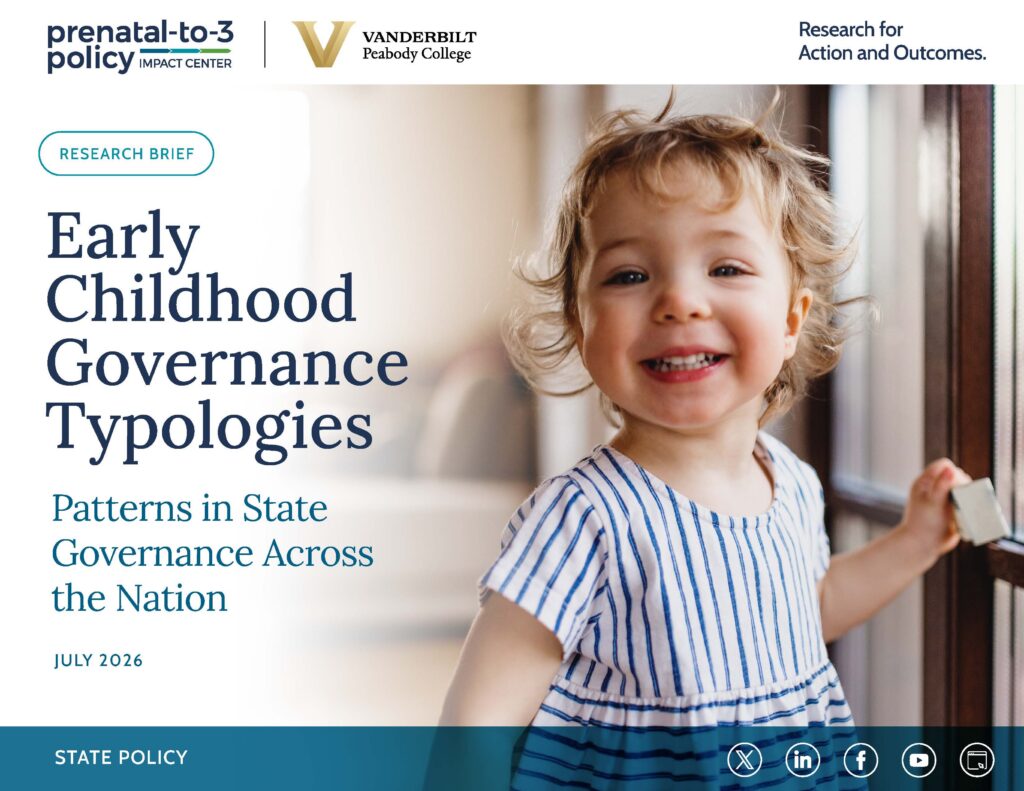
State choices in early childhood governance shape whether families can easily find and access the services their children need, as well as the efficiency and effectiveness of service provision. In our typologies research brief, the Prenatal-to-3 Policy Impact Center describes the patterns that emerged in a landscape scan of how all 50 states and the District of Columbia organize early childhood programs.
The report posits that governance choices reflect state goals and can be organized into three typologies: whole child, school readiness, and parents’ workforce participation.
Examples & Takeaways
Case Studies: Examining the Nuances of State Choices
To better understand the variation and nuance in state governance choices, the Policy Impact Center is conducting case studies of several states to examine the benefits and challenges of different governance strategies. Though there is currently a trend toward creating new departments focused on early childhood, our upcoming work will identify best practices and lessons learned of a variety of approaches to governance.
Kansas
This brief provides the case study findings for Kansas. For the case study, we interviewed 10 early childhood leaders in Kansas representing state government, non-profits, providers, researchers, and advocates. Our findings summarize what we learned through these interviews.
New Mexico
This brief provides preliminary case study findings for New Mexico. For the case study, we interviewed seven early childhood leaders in New Mexico representing state government, child care business owners, the business community, non-profits, and advocates. Our findings summarize what we learned through these interviews.
Ohio
This brief provides the case study findings for Ohio. For the case study, we interviewed seven early childhood leaders in Ohio representing state government, non-profits, and advocates. Our findings summarize what we learned through these interviews.
South Carolina
This brief provides the case study findings for South Carolina. For the case study, we interviewed 11 early childhood leaders in South Carolina representing state government, academia, nonprofits, and advocates. We selected South Carolina in part because of their recent development of a coordinated eligibility assessment (First 5) for early childhood programs and services but found through our interviews a much more complex story that does not center the eligibility assessment. Our findings summarize what we learned.
Virginia
This brief provides the case study findings for Virginia. For the case study, we interviewed 11 early childhood leaders in Virginia representing state government, child care business owners, health care providers, nonprofits, and advocates. Our findings summarize what we learned through these interviews.
Lessons Learned from Case Studies
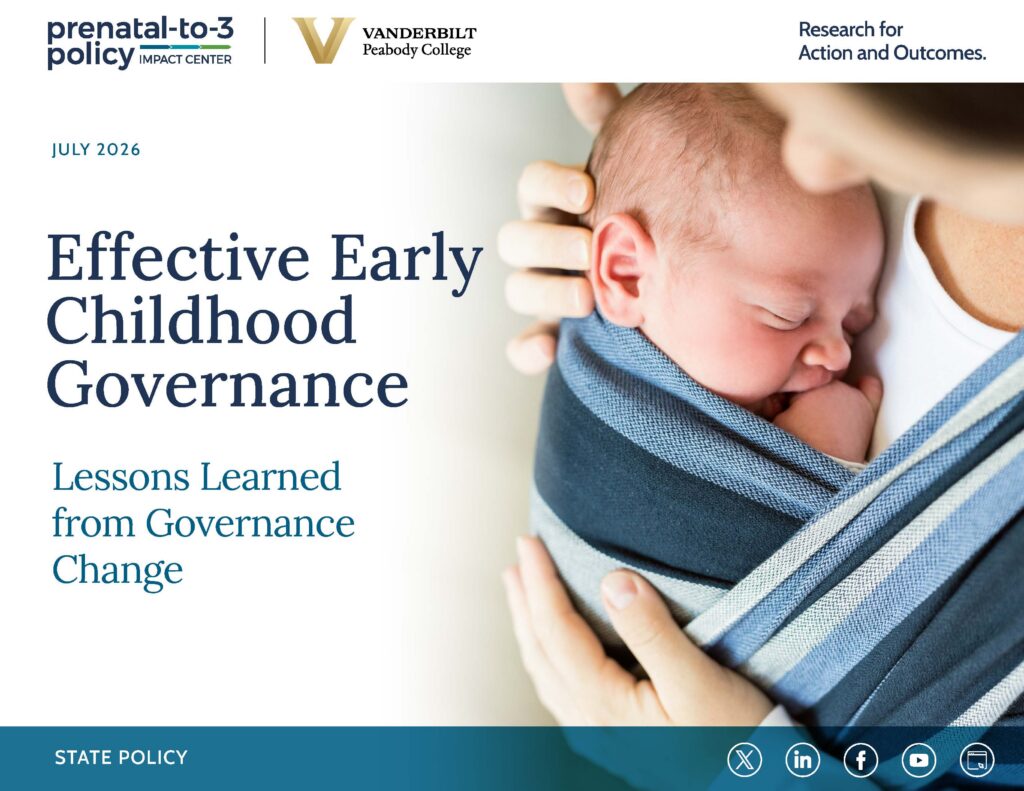
To better understand the benefits and challenges of different governance strategies and identify best practices and lessons learned from states to inform effective and efficient early childhood governance, the Prenatal-to-3 Policy Impact Center conducted in-depth case studies on the governance structures of five states (Kansas, New Mexico, Ohio, South Carolina, and Virginia).
Drawing on these case studies, this brief identifies seven lessons learned, from sustained advocacy to strong, collaborative leadership, that can help state better understand how governance choices connect to early childhood goals.
Governance Structures
Variation in Governance
Examples & Takeaways
Please direct any comments, questions, or corrections to pn3center@vanderbilt.edu with the subject line “EC Governance – State Name.”
Acknowledgements: Thank you to the state leaders that provided data clarifications and to our colleagues at the Center for American Progress and Education Commission of the States for their support and collaboration.
