Lorem ipsum dolor sit amet, consectetuer adipiscing elit, sed diam nonummy nibh euismod tincidunt. Learn More

Brief: State policy progress on expanded income eligibility for health insurance in 2023

PRINT

Expanded income eligibility for health insurance is one of 12 evidence-based policies included in our 2023 Prenatal-to-3 State Policy Roadmap, which details states’ progress toward adopting and implementing policies that effectively improve child and family wellbeing.

State policy choices on Medicaid income eligibility for adults can significantly impact the degree to which families are able to access health insurance, especially during the perinatal period, including for family planning services, preventive care before conception, and prenatal care in the earliest stages of pregnancy.

In 2023, nine states introduced legislation to expand Medicaid under the ACA. Of those, one state successfully enacted legislation, and another implemented Medicaid expansion following a successful ballot initiative. Several states also took action to improve access to health insurance, such as lengthening the duration of pregnancy Medicaid coverage from 60 days to 12 months postpartum and extending coverage to additional populations.
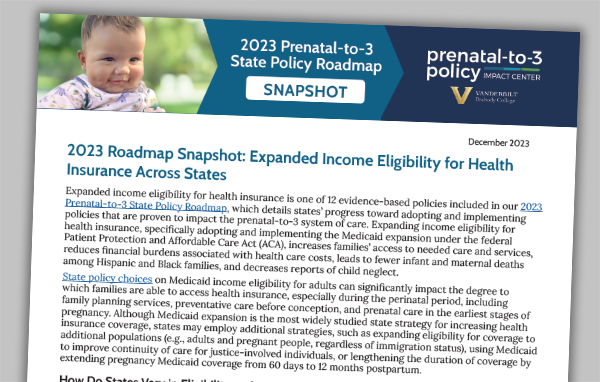
Read the brief for more details on state progress.

The recently updated Prenatal-to-3 State Policy Roadmap provides insight into the core policy levers and further illustrates their interplay through vivid graphics, showcasing the variation in Medicaid policies across states.

Explore the Roadmap to gain a deeper understanding of the policies shaping Medicaid coverage across the states.

Related

Kids sitting in a classroom

New Vanderbilt Study Finds Nashville Child Care System Faces Interconnected Challenges in Supply, Workforce, and Affordability

As families across the country navigate the pressures of finding and affording child care, new research from Vanderbilt University’s Prenatal-to-3 Policy Impact Center examines what that landscape looks like in greater Nashville, Tennessee Nashville, Tennessee
Set of kid toys on a white shelf

Brief 5: Estimating the True Cost of High-Quality Home-Based Care – Insights from True-Cost Modeling

Home-based child care plays a small but vital role in greater Davidson County, Tennessee, offering families flexibility, affordability, and culturally aligned care, particularly for infants and toddlers. This brief uses a cost estimation model to examine the true cost of providing high-quality home-based child care in the region, where providers often serve simultaneously as educator, owner, and director.
Little boy playing with toy train.

Brief 4: What High-Quality Center-Based Child Care Really Costs, and Why No One is Paying It – Insights from True-Cost Modeling

The market price of child care reflects what families can afford to pay, not what it actually costs programs to provide high-quality care with a well-compensated workforce. This brief uses a cost estimation model to examine the true cost of providing center-based child care for children under age 5 across greater Davidson County, Tennessee.