A decade ago, in 2016, the state policy landscape to support families with young children was largely made up of targeted interventions and programs including home visiting, Early Intervention services, and child care. At the time, broad-based support was limited to Medicaid expansion in two-thirds of states and a state earned income tax credit in half of states.
See how the prenatal-to-3 policy landscape changed over the past decade
Fast forward 10 years to today, in 2026, and the state policy landscape for families with young children reflects what the research has made clear— broad-based economic and family supports are the foundation of a system of care for families. Ensuring families have access to needed services, are able to work and provide care, and have sufficient household resources are key to the health and wellbeing of parents, caregivers, and children.
The investments states have made over the last decade have been transformative, totaling over 250 policy changes to support families with young children.
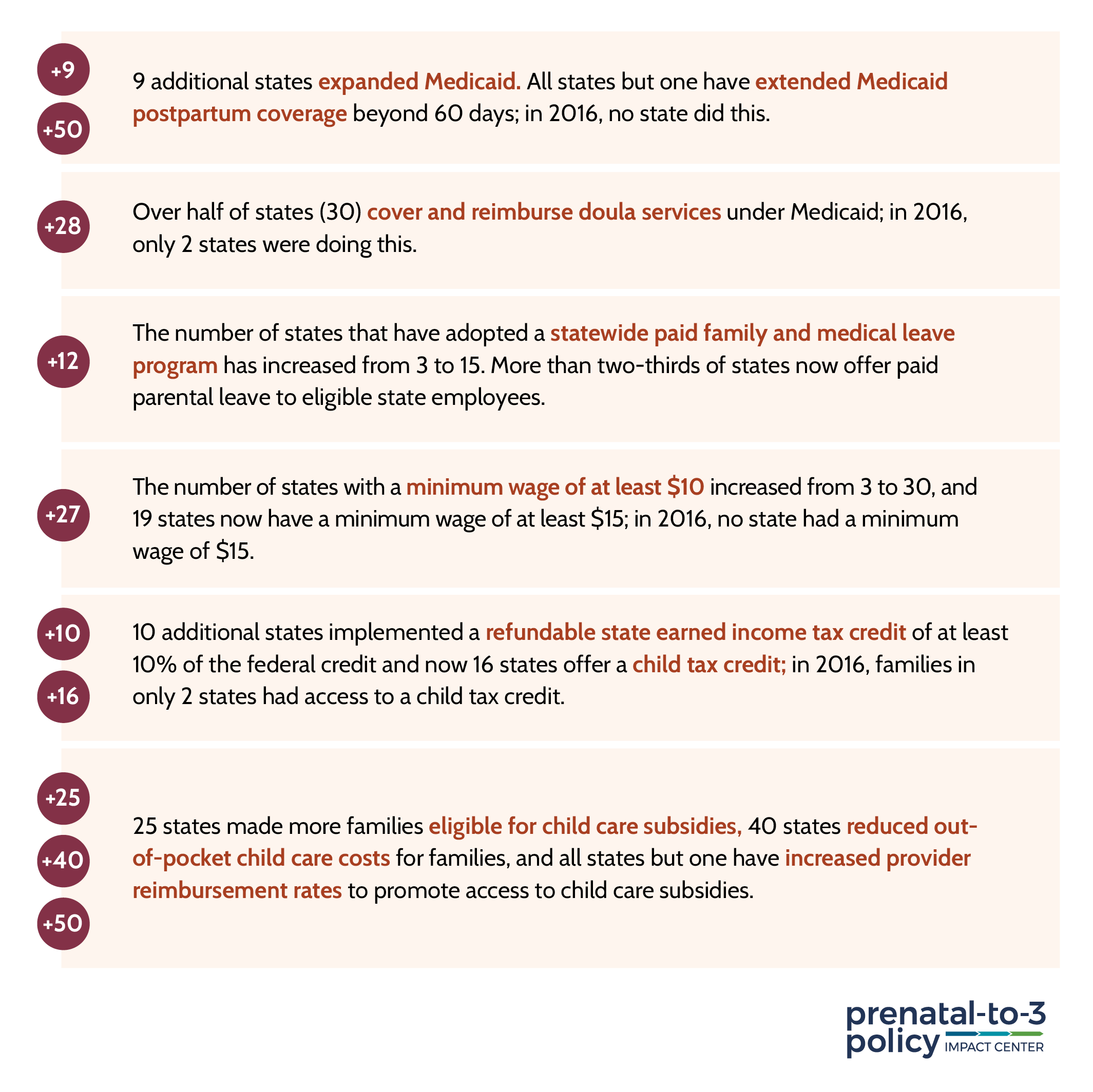
The impact of states’ progress over the last decade is similarly significant.
2.2
million
1
million
1
million
11
million
12
million
State policy choices matter.
Millions of families with young children have benefited from the hundreds of investments states have made since 2016. The last decade saw a system of care for families transformed from a landscape characterized largely by targeted interventions to one that now includes broad-based economic and family supports.
Policy progress takes place within an ever-changing political and economic landscape. States that have made significant progress over the last decade will need to determine how to maintain their investments and equitably implement the policies they have adopted. States that have made relatively few investments will need to prioritize the goals they have for children and families and push toward adopting effective policies, though this may prove more challenging in the years ahead
See how the prenatal-to-3 policy landscape changed over the past decade
Suggested Citation
Prenatal-to-3 Policy Impact Center (2026). Ten Years, Hundreds of Policies, Millions of Families: Transforming the System of Care for the Earliest Years. Peabody College of Education and Human Development. Vanderbilt University. https://pn3policy.org/