
The race, gender, and socioeconomic status of intended beneficiaries have played a measurable role in policymaking, particularly influencing eligibility and access to public supports for families of color earning low incomes. Our social policy history timelines highlight the evolution of inequities caused by patterns of exclusionary policymaking.
From Design to Disparities: How Inequitable Access Evolved Over Time
Social and economic inequities have emerged through layered systems of power and social norms, resulting in the inequitable distribution of public resources to certain communities across America today. Though these disparities trace back centuries, the effects of structural inequities have often extended the life cycle of economic precarity across generations.
To understand how we can better design policies that are accessible and effective, we must first understand how inequitable access to public support systems has been sustained.
The paid family leave and child care timelines reflect content from policy history reports published in December 2025. Scroll through key moments in time and follow the accumulation of inequities in policy design through the years.
TIMELINES
The History of Paid Family Leave Policies
- Introduction
-
1600s – 1864
Early America -
1865-1913
Post Civil War and Turn of the 20th Century -
1914-1920s
World War I and the Progressive Era -
1930s
The Great Depression and the New Deal -
1940s-1950s
World War II and Postwar Period -
1960s-1970s
The Civil Rights Movement and a Changing Workforce -
1980s-1990s
Welfare Reform and the Evolution of FMLA -
2000s- Present
Paid Family Leave in the 21st Century
The History of Child Care Policies
- Introduction
-
1600s – 1800s
Colonial Settlement through Reconstruction -
1900s – 1920s
The Progressive Era -
1930s
The Great Depression -
1940s – 1950s
World War II and Postwar Period -
1960s – 1970s
The Civil Rights Movement -
1980s
The Reagan Revolution -
1990s – 2010s
Welfare Reform -
2020 - Present
The COVID-19 Pandemic
Discover the Full Social Policy Histories
Access all reports and supporting
resources in one place.
The History of Paid Family Leave Policies
Introduction
Our analysis illustrates the historical timeline of labor and family policies that shape present-day paid family leave policies. Inequities in the accessibility and affordability of paid family leave have been influenced by narratives that some families (most often families experiencing poverty and families of color) are less deserving of financial support and legal work protections.
As a result of historical policy design, many workers of color remain less likely to meet eligibility requirements for either paid or unpaid leave and are less likely to be able to afford to take time away from work to bond with a new child when available.
Trace the path from past to present and explore the evolution of paid family leave policies.
Early America (1600s – 1864)
The colonization and subsequent development of the United States was fraught with inequities, including in caregiving dynamics. Enslaved, and later free, Black women were often coerced into caring for White children to the detriment of their own. Free women had few individual rights; their labor and any subsequent wages were the property of male family members.
Colonialism
The colonization of North America by Europeans resulted in the mass depopulation of Native Americans through devastating epidemics and violent conflict. Later, the US maintained a national policy of continuous expansion which conflicted directly with Native sovereignty and ultimately led to the genocide and displacement of Native American peoples. In turn, White colonists created wealth for themselves from the stolen land by imposing systems of private property ownership and extracting natural resources.
Slavery
The legal system of chattel slavery denied the humanity of Black people and the validity of Black family units, while White slave holders exploited Black labor and amassed wealth. Specifically harmful to enslaved women was the commodification of Black motherhood. Through the practice of wet-nursing, enslaved Black women were forced to breastfeed the children of slaveholders while their own children went undernourished.
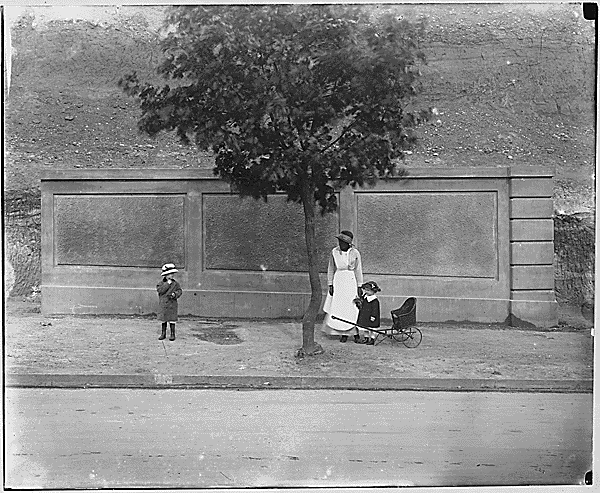
Woman employed as a domestic worker with small children at Meridian Hill Park in Washington, D.C. (Source: National Archives Catalog)
Coverture
By law and custom, a married woman was considered subordinate to her husband and had few individual rights. Under the legal doctrine of coverture, the labor of a married woman and any earnings generated from it were the legal property of her husband (or her father if not married).
Separate Spheres
Especially following the specialization of labor during the Industrial Revolution, there was a cultural norm of “separate spheres,” wherein public life, politics, and paid work were the domain of men, and work inside the home, especially caring for children, was seen as inherently feminine. The naturalization of motherhood, or the idea that women had an inherent ability and innate desire to care for children, was used to justify the devaluation of women’s labor.
After the legal system of chattel slavery ended, states and institutions used segregation, racist pseudo-science, intimidation, and violence to maintain a racial caste system. The federal government also forcibly removed many Native American children from their families and placed them in boarding schools. At the same time, the medical field propagated untrue ideas about differences by race and class related to the need for postpartum recovery.
1867, Reconstruction Act
Along with the 13th, 14th, and 15th amendments to the Constitution, and the creation of the Freedmen’s Bureau, the Reconstruction Act of 1867 set terms for the readmittance of Southern States into the Union and provided resources to emancipated Black Americans and poor White Southerners following the Civil War. Between 1860 and 1870, the Black-White wealth gap was reduced by half as Black Americans increasingly owned land and businesses, though White households still held more than 20 times the amount of wealth held by Black households. The Reconstruction Era was short-lived; the Freedmen’s Bureau was abolished in 1872, and remaining federal troops withdrew from the South in 1877, marking the end of Reconstruction.
1877, Beginning of Jim Crow Era
After Reconstruction ended, new laws, commonly referred to as Black Codes or Jim Crow laws, were put in place at the state and local levels to limit the economic, social, and civil lives of free people of color. Black people continued to experience overt discrimination, oppression, and racial terror as White people, particularly but not exclusively in Southern states, strived to maintain and enforce a racial caste system. Limited employment opportunities resulted in most Black women pursuing “gender-appropriate,” low-wage roles typically in the service of White, middle-class households. Black farmers in the South were kept from accessing federal loans by discriminatory local administrators and faced land theft by way of violence and intimidation.
The Progressive Era in the early 20th century was defined by the labor and women’s movements, which worked to build political power for historically excluded groups and reform exploitative or exclusionary systems. However, institutional racism within these movements meant that political power (and benefits) remained concentrated within White constituencies.
Exclusionary Labor Union Practices
The American Federation of Labor (AFL), the dominant national labor union in 1920, embraced nativism and focused on organizing unions of skilled craftsman, which systematically excluded Black workers and women. The AFL ignored the plight of Black workers and showed overt racism toward Asian workers.
1919, International Labor Organization’s (ILO) adopts the Maternity Protection Convention
An international movement advocating for fair treatment of women in the labor force led to the International Labor Organization’s (ILO) adoption of the Maternity Protection Convention of 1919, which called for 12 weeks of paid maternity leave, free medical care during and after pregnancy, and job protection. However, this convention was not a requirement of ILO membership and few countries ratified it at the time (the US not being one of them).
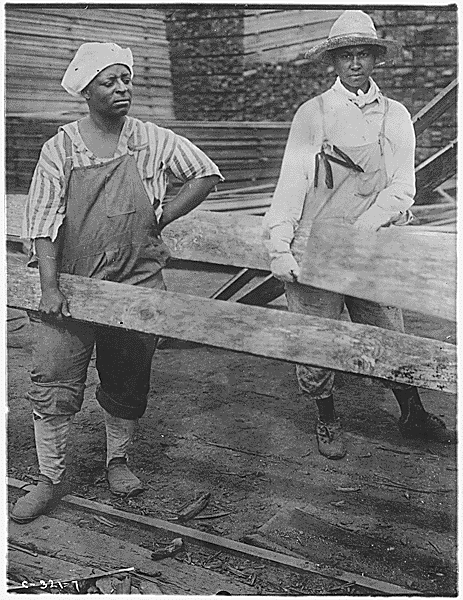
Black women at work in lumber yards in 1919. (Source: US Department of Labor. Women’s Bureau.)
1920, Ratification of 19th Amendment
The 19th Amendment legally granted women the right to vote. Race-based voting restrictions in the Jim Crow South meant that the new right was only guaranteed for White women. Despite benefiting from decades of solidarity, White feminist reformers largely abandoned Black women upon gaining their franchise, beginning with ignoring calls for an investigation of voting rights violations experienced by Black women during the 1920 election. Wealthy and politically active White women also resisted any legal protections for domestic service workers, because their own participation in public life relied on household labor performed by working-class women, who were often women of color who worked long hours for little pay.
The Great Depression and the New Deal (1930s)
Black workers were “first fired and last hired” when unemployment spiked during the Great Depression. Worker protections codified in the Social Security and National Labor Relations Acts of 1935 and the Fair Labor Standards Act of 1938 excluded occupations in which Black workers were concentrated.
1935, National Labor Relations Act (Wagner Act)
In 1935, the National Labor Relations Act provided the right to seek better working conditions and designation of representation without fear of retaliation. Among other groups, the Wagner Act originally excluded agricultural and domestic service workers; occupations in which Black workers were concentrated due to widespread employment discrimination.
1938, Fair Labor Standards Act
The Fair Labor Standards Act of 1938 (FLSA) serves as the foundation of legal protections for American workers. The FLSA established the 40-hour workweek, overtime protections, and the federal minimum wage, and heavily restricted child labor. These laws left millions of American workers uncovered, however, largely through the exclusion of agricultural and domestic workers, two occupations in which Black workers (especially in the South) were concentrated due to racial discrimination in hiring for covered occupations.
World War II and Postwar Period (1940s – 1950s)
World War II left many new mothers separated from their spouses and extended families and drew many mothers into the workforce. Supports for these parents expanded during the war and quickly contracted when it was over. After the war, wealth transfers such as the G.I. Bill were largely limited to White, middle-class families, widening the racial wealth gap.
1940, Lanham Act
In 1943, federal funds allocated through the Lanham Act of 1940 began supporting subsidized child care in war-impacted areas so that mothers could work in war industries. Child care centers funded through the Lanham Act closed in 1946.
1943, Emergency Maternal and Infant Care Program
The Emergency Maternal and Infant Care (EMIC) program was established in 1943 to support military wives with prenatal, birth, and postpartum care. To support military spouses living away from their family and social support systems, the EMIC provided eligible mothers with six visits by a postpartum visiting nurse if both mother and baby were healthy and 12 visits if either was ill. The EMIC program ceased operations in 1949.
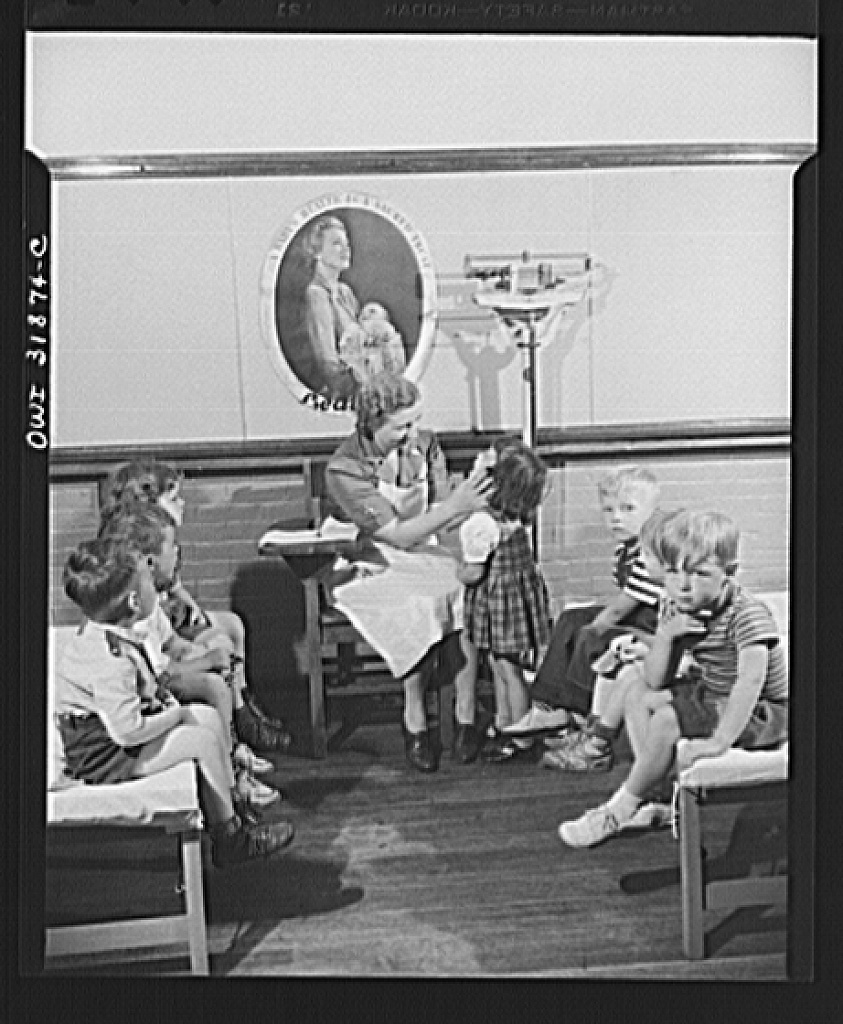
Children and a nurse at a child care center in New Britain, Connecticut. The center opened in 1942 and provided care for mothers engaged in work in the war industry. (Source: Library of Congress)
1944, Servicemen’s Readjustment Act (G.I. Bill)
The G.I. Bill provided returning veterans with benefits such as college tuition, low-cost mortgages, and low-interest business loans. These subsidized loans accelerated the growth of a largely White middle class and allowed White families to build household wealth that could be transmitted across generations. Although ostensibly inclusive of all service members, administration of the G.I. Bill was devolved to state and local agencies. In the South, this meant that many Black veterans could not access G.I. Bill benefits due to discrimination in state and local administration.
The Civil Rights Movement and a Changing Workforce (1960s – 1970s)
This period saw dramatic increases in labor force participation by Black and White women. Due to discrimination, however, gains in college attendance, professional degree attainment, and higher-wage professional jobs were greatest for White women. The Pregnancy Discrimination Act (PDA) of 1978 barred pregnancy discrimination in all states, and extended protections for unpaid medical leave for pregnant and postpartum people in five states with existing Temporary Disability Insurance (TDI) programs.
1964, Title VII of the Civil Rights Act
Title VII of the Civil Rights Act of 1964 barred discrimination by employers and labor unions, including in hiring, firing, promotion, pay, and terms and conditions of employment, and additionally prohibited discrimination in these areas on the basis of sex. These prohibitions built on protections codified in the Equal Pay Act of 1963, which guaranteed “equal pay for equal work,” and barred employers from paying a woman less than a man performing a comparable job.
1978, Pregnancy Discrimination Act
The Pregnancy Discrimination Act (PDA) of 1978 amended Title VII to close a key loophole – the law clarified that pregnancy discrimination is a form of sex discrimination, and prohibited employment or workplace discrimination based on current, past, or potential pregnancy or medical conditions related to pregnancy and childbirth. The PDA required that states and employers that provide workers with temporary disability insurance also provide benefits to workers who are temporarily unable to work due to pregnancy or childbirth. This new requirement meant that beginning in 1979, the five states with state Temporary Disability Insurance (TDI) programs (California, Hawaii, New Jersey, New York, and Rhode Island) provided paid leave to pregnant workers to be used in the period immediately before and after birth.
Welfare Reform and the Evolution of FMLA (1980s – 1990s)
As women’s labor force participation continued to rise, interest in the intersection of work and caregiving responsibilities also increased. The Family Medical Leave Act of 1993 (FMLA) offered the first federal protections for parents with a new child to take unpaid leave. However, restrictive eligibility criteria left workers who were disproportionately people of color unprotected. Even among those eligible for federal job protections under the FMLA, most workers lack the resources to afford even 6 weeks of unpaid leave and Black, Hispanic, and Native American workers are less likely than their White or Asian counterparts.
1993, Family and Medical Leave Act
The Family and Medical Leave Act (FMLA) was signed into law in 1993. The enacted law guarantees 12 weeks of unpaid, job-protected family and medical leave per year and covered less than half of American workers. The FMLA closed gender gaps in access to job-protected leave and was found to increase leave taking among women employed full-time. However, a minimum work hours requirement functionally excluded part-time workers who are more likely to experience job instability and have fewer household resources to weather economic instability such as job loss or lost wages, and who are more likely to be women of color.
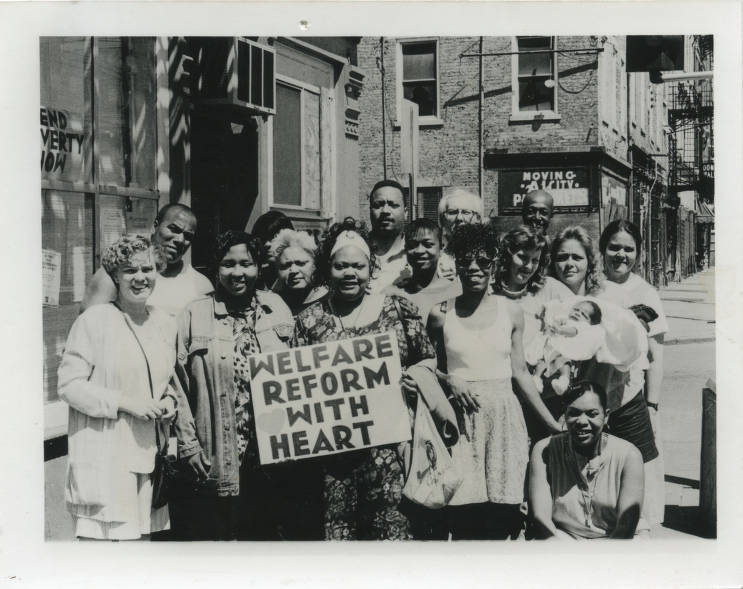
Group holding sign “Welfare Reform with Heart” on sidewalk in Cincinnati, Ohio. (Source: Cincinnati & Hamilton County Public Library. Genealogy and Local History Department)
1996, Personal Responsibility and Work Opportunity Reconciliation Act
The Personal Responsibility and Work Opportunity Reconciliation Act (PRWORA) replaced the existing program for cash welfare with the more stringent Temporary Assistance for Needy Families (TANF). To maintain eligibility for cash welfare, TANF recipients had to work or engage in approved welfare-to-work activities (e.g., vocational training) for a minimum number of hours per week. These work requirements pushed TANF recipients, disproportionately single mothers of color, to accept any job they could be hired for, regardless of pay or conditions, to maintain their benefits. Studies show that parents that left TANF due to employment were in low-paying, unstable jobs with household incomes below the federal poverty level. This exacerbated existing labor market segmentation and pushed workers into jobs that were unlikely to be eligible for FMLA protections.
Paid Family Leave in the 21st Century (2000s – Present)
In the 21st century, new paid family leave policies at the state and federal levels suggest the start of a new era for American families. Due to occupational segregation and a patchwork of state policies, workers of color are still more likely to work in unstable or part-time jobs and therefore least likely to receive job-protected, paid leave following a birth, adoption, or foster placement.
2002, California Paid Family Leave
In 2002, California became the first state to enact a statewide paid family leave policy and in 2004, nearly every worker in the state gained access to 6 weeks of leave reimbursed at 55 percent of their weekly earnings (up to a maximum weekly amount), in addition to paid leave available to parents who give birth through California’s pre-existing temporary disability insurance (TDI) policy. The low wage replacement rate made taking leave unaffordable for workers with low wages and low uptake among families most in need of support dampened the policy’s effects.
2020, Federal Employee Paid Leave Act (FEPLA)
Congress passed legislation to provide paid parental leave to civilian employees of the federal government in 2019. The Federal Employee Paid Leave Act (FEPLA) amended the FMLA to provide up to 12 weeks of paid parental leave to covered federal employees in connection with the birth or placement (by adoption or foster care) of a child, beginning October 2020. FEPLA has mixed implications for racial equity; as of 2020, Black, White, and Asian workers were overrepresented in the federal workforce and therefore disproportionately benefit from the expansion of paid parental leave for federal workers, whereas Hispanic workers were underrepresented.
2023, Pregnant Workers Fairness Act (PWFA)
The Pregnant Workers Fairness Act (PWFA), the final regulations for which became effective on June 18, 2024, requires employers with 15 or more employees to make reasonable accommodations for employees who have a known limitation stemming from pregnancy, childbirth, or related medical conditions unless the accommodation poses an undue hardship to the employer, regardless of the employee’s tenure with the job or employer. Accommodations include providing unpaid, job-protected leave to recover from childbirth. This dramatically expands access to job-protected, unpaid leave for employees of small businesses or workers with a recent job change, who are excluded under the FMLA. However, the PWFA does not replace lost income and does not extend protections for parents that have not given birth.
The History of Child Care Policies
Introduction
Our historical analysis illustrates the throughlines from our country’s earliest child care policies to today’s subsidy systems, with a particular focus on the racial equity of policy design and implementation over time.
In doing so, we found that the attempts to exclude non-White recipients and, if included, limit the generosity of aid, creates unique, inequitable barriers for families of color while also undermining the foundation of the subsidized care system for all families with low incomes.
Discover the moments that shaped inequity in child care policies and see the ripple effects on families today.
Colonial Settlement through Reconstruction (1600s – 1800s)
The colonization and subsequent development of the United States was fraught with inequities, including in caregiving dynamics. Enslaved, and later free, Black women often cared for White children, and many Native American children were forcibly enrolled in boarding schools.
Slavery
The legal system of chattel slavery practiced starting in the early Western colonization of America denied the humanity of Black people and the validity of Black family units while allowing White slave holders to exploit Black labor and amass wealth. Specifically, many enslaved women were tasked with raising the slave master’s children while their own children were forced to labor, creating the “mammy” stereotype.
Even following emancipation, Black women had little choice in work and were consistently underpaid, with one of the most commonly held occupations being domestic workers. Black women that did work often relied on community care, also known as fictive kin, for child care.
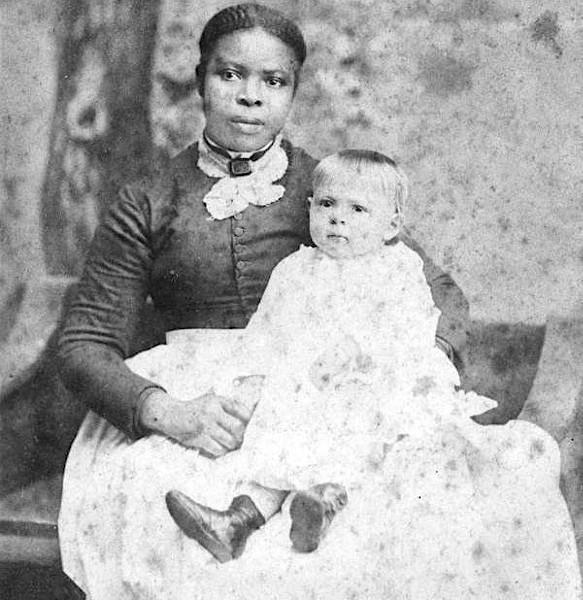
“Aunt Judy,” a formerly enslaved woman, was employed as a wet nurse by the Walker family,
1835. (Source: State Library and Archives of Florida)
Boarding Schools
Native American families were consistently pressured, at times violently, to assimilate into White culture; this included Native American children, with children as young as age 3 voluntarily or forcibly enrolled in boarding schools. Government-funded and often church-run, boarding schools were implemented with the explicit goal of cultural genocide and often used violent means to make the children in their care comply.
The Progressive Era (1900s – 1920s)
At the turn of the 20th century, state-funded mothers’ pensions were popularized to allow mothers to stay home and care for their children; yet, mother’s pensions were inequitably implemented, restricting eligibility to the “deserving poor.”
Mother’s Pensions
Mother’s pensions provided financial assistance to mothers with low incomes who faced circumstances outside their control (i.e., widowed, deserted, divorced) to stay home and care for their children. Yet, biased interpretations of “deservingness” caused immigrant, working-class, and especially Black women to be more frequently judged as less capable of fulfilling their mothering responsibilities and therefore not eligible for pensions.
The Great Depression (1930s)
The economic collapse in the 1930s spurred the federal government to provide financial assistance, via the Aid to Dependent Children (ADC) program, for mothers with low incomes to stay at home and care for their children. States had significant control in the implementation of ADC, and as the population served became less White, support for the program weakened.
Emergency Nursery Schools
During the Great Depression, the Works Progress Administration established the first federally funded early learning program, Emergency Nursery Schools (ENS) for parents who were unemployed and seeking work. ENS programs were established in most states, but access was variable; only half of states offered segregated programming for children of color and all programs had a limited number of slots.
1935, Social Security Act
Title IV of the Social Security Act established the Aid to Dependent Children (ADC) program to provide financial assistance to mothers with low incomes to stay home and care for their children. Modeled on mother’s pensions, ADC became the foundation for all federal welfare and child care policies that followed; embedded in this foundation were many inequitable practices, including subjective judgements of “deservingness” of aid that often led to the exclusion of Black mothers and, when aid was granted, financial assistance remained inadequate.
World War II and Postwar Period (1940s – 1950s)
Mothers’ participation in defense work during World War II prompted additional, time-limited federal supports for child care. In the postwar period, increased financial prosperity was largely limited to White families, and the proportion of Black families accessing ADC grew. Despite ADC program goals remaining centered on in-home childrearing, discriminatory state policies and inadequate financial support forced mothers with low incomes, particularly Black mothers, into the workforce.
1940, Lanham Act
With many mothers of young children recruited to work in the defense industry during the war, the Lanham Act, which provided funding to create community facilities in war-impacted areas, was used to fund child care centers for working mothers. Local communities administered child care programs but faced significant challenges in implementation, including an inadequate number of slots and high staff turnover because of a lack of resources and low wages. Furthermore, Black and Hispanic families regularly experienced racial discrimination in child care admissions policies.
State ADC Policies
As the total number of ADC recipients grew (and more Black mothers accessed aid), states used their authority to institute additional punitive policies that disproportionately affected Black families. Policies included man-in-the-house rules, which denied aid to mothers who engaged in activities deemed morally or sexually deviant, and farm policies, which restricted access to benefits during planting and harvest seasons to force Black recipients to engage in agricultural labor.
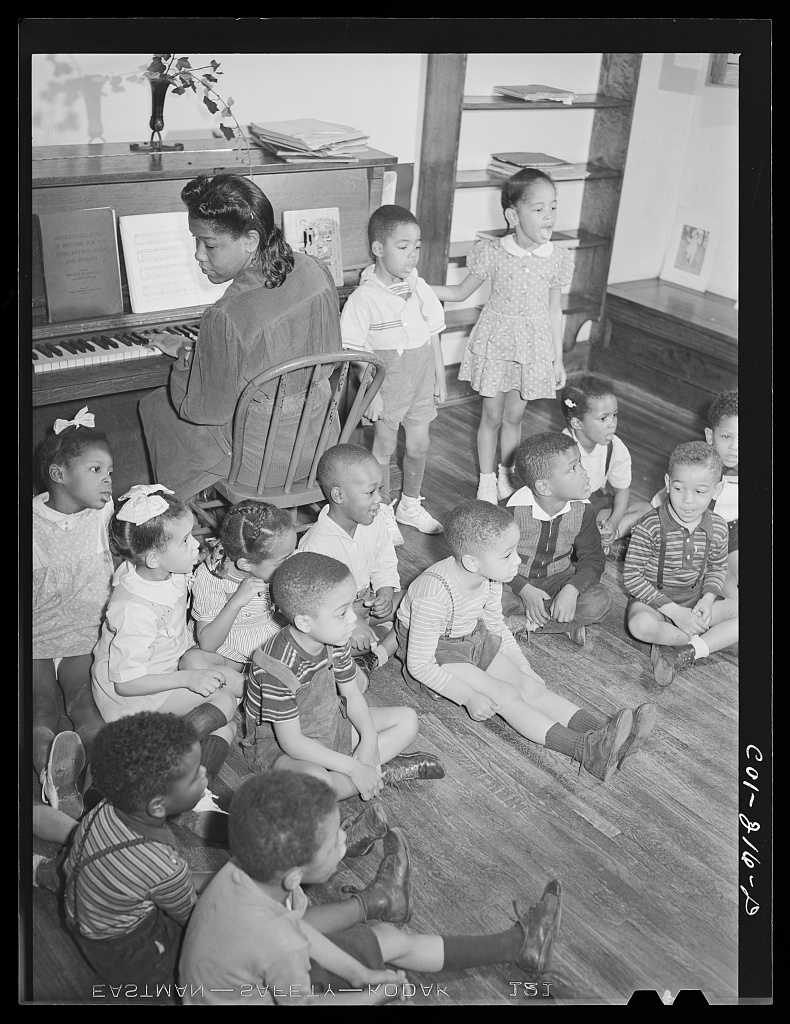
Nursery school music class, Atlanta, GA, 1942. (Source: Library of Congress)
The Civil Rights Movement (1960s – 1970s)
Welfare reform in the 1960s led to the introduction of work incentives and child care subsidies for out-of-home care. The shift away from cash assistance to allow mothers to stay home to care for their children was largely in response to a perceived increase in Black individuals receiving aid under expanded eligibility requirements.
1962, Public Welfare Amendments
The Public Welfare Amendments of 1962 introduced the most comprehensive overhaul of welfare and child care since its creation. Addressing long-standing concerns that ADC encouraged single-parent homes, the Public Welfare Amendments of 1962 retitled ADC as the Aid to Families with Dependent Children (AFDC) and extended benefits to married, two-parent families with one unemployed parent to emphasize the traditional family unit and promote marriage. In response to increased eligibility, particularly Black families’ eligibility, the Amendments also established the first welfare-to-work program, the Community Work and Training (CWT) program; this marked a distinct shift in AFDC priorities from in-home caregiving support (with recipients imagined as White) to out-of-home child care provisions to support workforce participation (with recipients imagined as Black).
1967, Social Security Amendments
When AFDC costs and rolls were not reduced by previous reforms, new requirements were introduced through the Social Security Amendments of 1967. Specifically, the CWT program was replaced by the Work Incentives program (WIN), with participation required for all recipients except mothers with children under age 6; states were required to assure child care for those in WIN, further solidifying the political conception of child care as a means to work. Nonetheless, welfare-to-work policies failed to address the systemic racism that limited economic opportunities for Black workers.
The Reagan Revolution (1980s)
Reducing welfare rolls continued to be a central policy goal in the 1980s, largely informed by racist narratives that Black families were taking advantage of the welfare system. For the first time, the Family Support Act made work a requirement and guaranteed child care for AFDC recipients; states were given significant control in implementing both measures.
1988, Family Support Act
The Family Support Act (FSA) of 1988 aimed to reduce welfare dependency and transition recipients into the workforce. A new work program, the Job Opportunity and Basic Skills Training (JOBS) program, was required for all AFDC recipients except mothers with children under age 3. To support parents’ workforce participation, child care was guaranteed, making it the first open-ended entitlement for child care in American history. Specifically, FSA included two subsidized child care programs: AFDC Child Care (AFDC-CC) program for parents currently receiving welfare and Transitional Child Care (TCC) for parents in their first year after unenrolling in AFDC.

Young children in class, 1989. (Source: Library of Congress)
1990, Omnibus Budget and Reconciliation Act
Shortly after the FSA was passed, two additional child care programs were implemented through the Omnibus Budget and Reconciliation Act of 1990. The first additional child care program, the At-Risk Child Care (ARCC) program, targeted families who would be “at risk” of qualifying for AFDC without access to child care subsidies. The second program enacted, the Child Care Development Block Grant (CCDBG) Act of 1990, is still in effect today and provides federal funding for child care subsidies and quality improvements.
With four distinct child care programs targeting four separate populations by the early 1990s, families with low incomes struggled to navigate the fragmented system and often failed to receive the necessary support in a timely manner.
Welfare Reform (1990s – 2010s)
Welfare reform under President Clinton separated child care subsidies from cash welfare benefits. Existing child care subsidy programs were combined into a single block grant, the Child Care and Development Fund (CCDF), which increased states’ control over program implementation; greater control allowed states to set more or less equitable policies concerning eligibility, copayments, etc., without federal interference.
1996, Personal Responsibility and Work Opportunity Act
PRWORA separated child care from welfare and established the Child Care and Development Fund (CCDF) and the Temporary Assistance for Needy Families (TANF) block grants, respectively. Concerning child care subsidies, the three child care programs associated with welfare (ADFC-CC, TCC, and ARCC) were repealed and consolidated under the Social Security Act, known as the Child Care Entitlement to States (CCES). Funding from CCES and CCDBG are maintained together as a single block grant program, the CCDF. Ultimately, the shift in fiscal policy to eliminate child care entitlements in favor of a block grant places the CCDF (and TANF) program and those it serves in a more vulnerable position because of fixed funding and increased state authority.
The COVID-19 Pandemic (2020 - Present)
The COVID-19 pandemic raised public awareness of long-standing challenges in the child care sector, resulting in significant allocations of relief funding and the 2024 CCDF rule changes to support a more sustainable and equitable child care system. Even so, states continue to struggle to address access and affordability for families.
Pandemic Relief Funding
In response to the ongoing crisis, Congress passed multiple relief bills (i.e., CARES Act, the CRRSA Act, and the ARPA), which included financial support to both child care providers and families in need of child care. The significant influx of funding from the relief bills into the child care sector created a unique moment for state leaders to focus on the equity of child care systems; changes to create more accessible child care systems, however, were time-limited in many states without sustainable funding.

3 year old girl playing at daycare while wearing a protective face mask to protect from the transfer of germs during phase 2 of reopening during COVID-19.
2024 CCDF Rule Change
In 2024, the federal Department of Health and Human Services released significant rule changes to CCDF, which encouraged or mandated states to adopt more equitable practices within 2 years (e.g., limiting family costs, improving provider payment policies). The rule changes will benefit both families and providers, although without additional funding to meet new requirements, it may divert funds from other improvements; as such, at this time it is unclear what systemwide impacts the rule changes will have.
About the Social Policy Histories
This multi-part report series examines how social policy developments from early America to today, were influenced by the race, gender, and socioeconomic status of intended beneficiaries.
Supported by a set of timelines, policy considerations, and history summary tables, the social policy histories offer valuable perspectives for those seeking to understand how patterns of exclusion have resulted in unequal outcomes for families earning low incomes, particularly families of color, and the inheritance of economic hardship across generations.

Policy History Timelines