For many working families, child care is a crucial service that allows parents to engage in work or pursue educational opportunities. Yet, child care is increasingly unaffordable, particularly for families with low incomes. Child care subsidies reduce the cost of care by providing financial assistance for families with low incomes.
Despite the strong need for child care subsidies, they remain difficult to access, and if accessed, may not cover the cost of high-quality care. The challenges of accessing child care subsidies today are the result of years of inequitable policy choices; Black, Hispanic, and Native American families have been and remain disproportionately unable to access subsidies.
As state leaders take action to strengthen child care systems and remove barriers for families with low incomes, particularly families of color, it is important to understand – how did we get here?

Access the full History of Child Care Policies
Mother’s Pensions Provided Financial Assistance to “Deserving” Mothers

The Western colonization of the United States was fraught with inequities, fueled by the dominant ideologies of patriarchy and White supremacy. As such, White women were expected to remain in the home, taking responsibility for childrearing; the continuous labor of Black women (first as enslaved then as free laborers) as caregivers to White children illustrates the racialized double standard of womanhood.
Nonetheless, at the turn of the 20th century, states began to establish mother’s pensions, which provided cash payments to mothers facing circumstances outside their control (i.e., widowed, deserted, or divorced). Mother’s pensions prioritized mothers’ ability to stay home and care for their children but were inequitably implemented, with eligibility restricted to the “deserving poor.”
The significant latitude counties had in implementing mother’s pensions was most often actualized through home “suitability” clauses, which allowed caseworkers to deny aid based on their assessment of the health and moral fitness of the home (and by extension, the mother). Biased interpretations of home “suitability” caused immigrant, working class, and especially Black women to be more frequently judged as less capable of fulfilling their mothering responsibilities and therefore not eligible for pensions.
Financial Assistance for “Deserving” Mothers Adopted as Part of Federal Welfare State
In 1935, spurred by the Great Depression, the federal government passed the Social Security Act (SSA). Among other safety net programs, Title IV of the SSA established the Aid to Dependent Children (ADC) program, which provided financial assistance for mothers with low incomes to stay at home and care for their children.
The ADC program was modeled on mother’s pensions, carrying forward many of its inequitable features. For example, subjective home “suitability” clauses restricted access, particularly for Black women; even for those deemed eligible, insufficient payments failed to cover the cost of living and often forced recipients into the workforce nonetheless. Furthermore, expansion of Social Security benefits to widows caused White widows to withdraw from ADC to enroll in Social Security, whereas most Black widows remained enrolled in the less generous ADC.
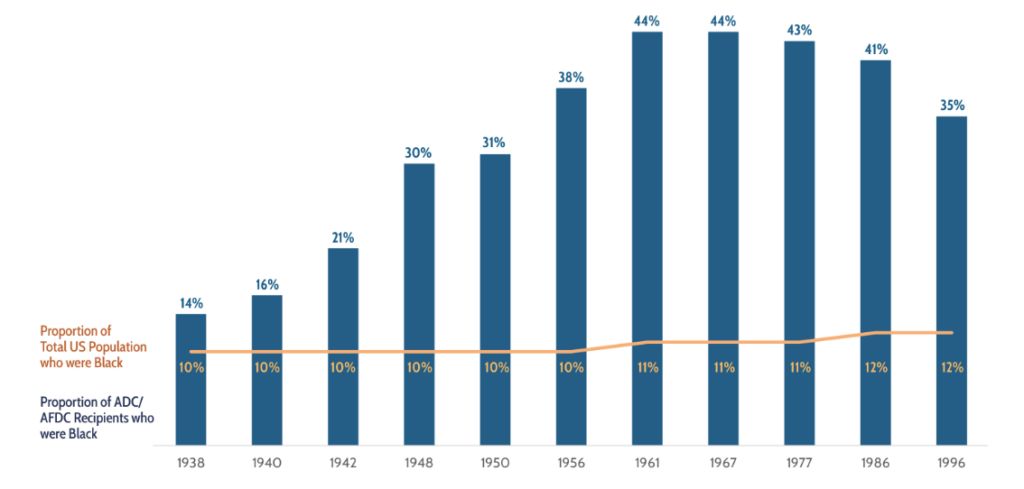
As the public increasingly perceived ADC to be serving Black families, support for the program weakened. Over the next 2 decades, federal budget increases were passed in return for increased state control to address the increasing number of ADC recipients (and thus increasing program costs) (see Figure 1). States instituted punitive rules, such as man-in-the-house rules and farm policies, which disproportionately limited Black families’ access to ADC.
Figure 1. Proportion of ADC/AFDC Recipients Who Were Black, 1938-1996
Welfare-to-Work Policies Include Provisions for Child Care Subsides
The Civil Rights movement, beginning in the mid-1950s and continuing into the 1960s, empowered Black communities and led to landmark legal protections. This progress was met with backlash as many White communities struggled to maintain racial dominance; racial tensions contributed to the public demonization of Black families with low incomes.
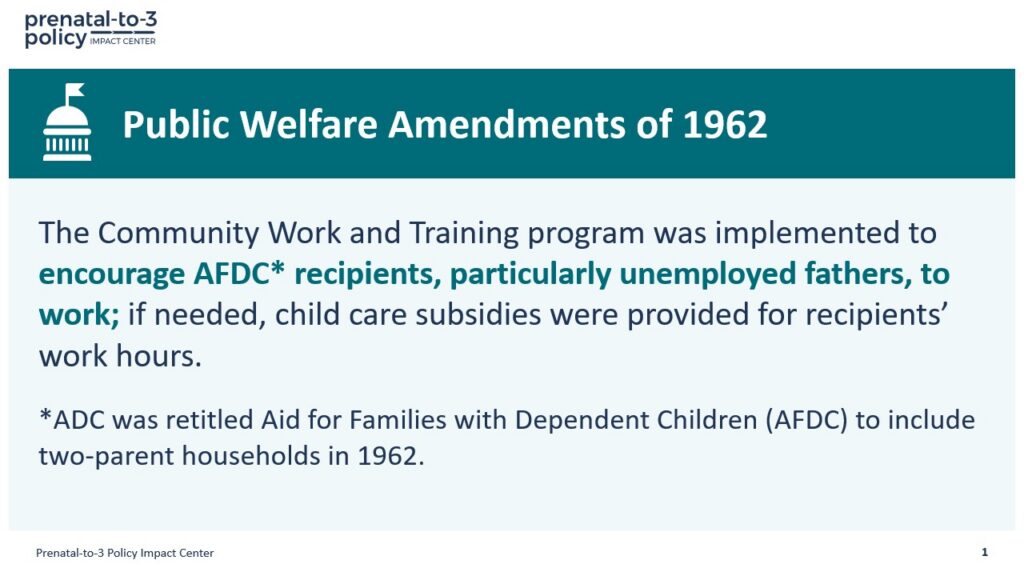
Negative public perceptions of Black families with low incomes allowed for the most comprehensive overhaul of public welfare since its creation. Specifically, ADC program goals that once centered on mothers’ staying home to care for their children became increasingly focused on providing out-of-home child care provisions to encourage women’s workforce participation (see Figure 2).
Figure 2. Welfare-to-Work Policies Subsidized Out-of-Home Child Care
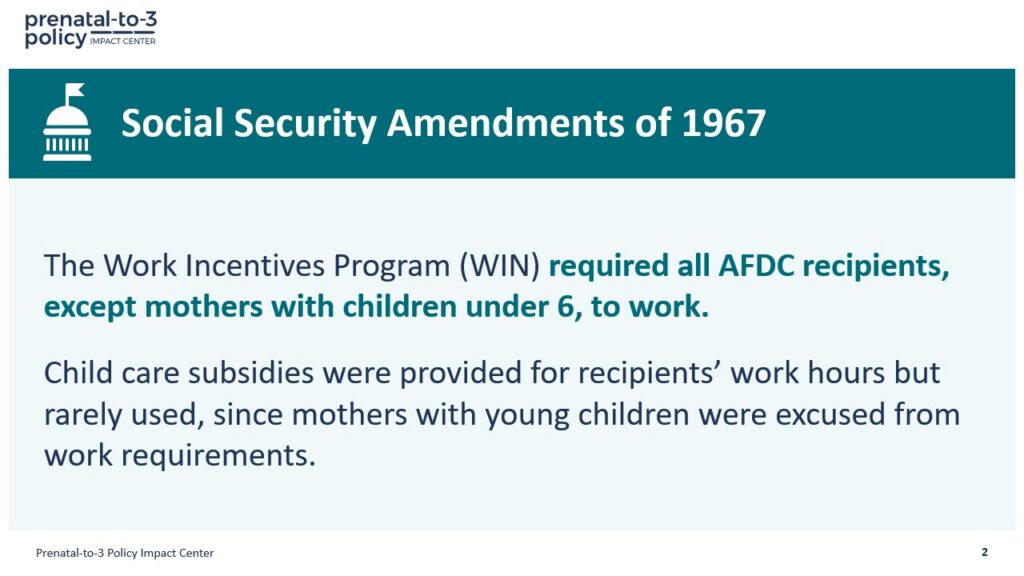
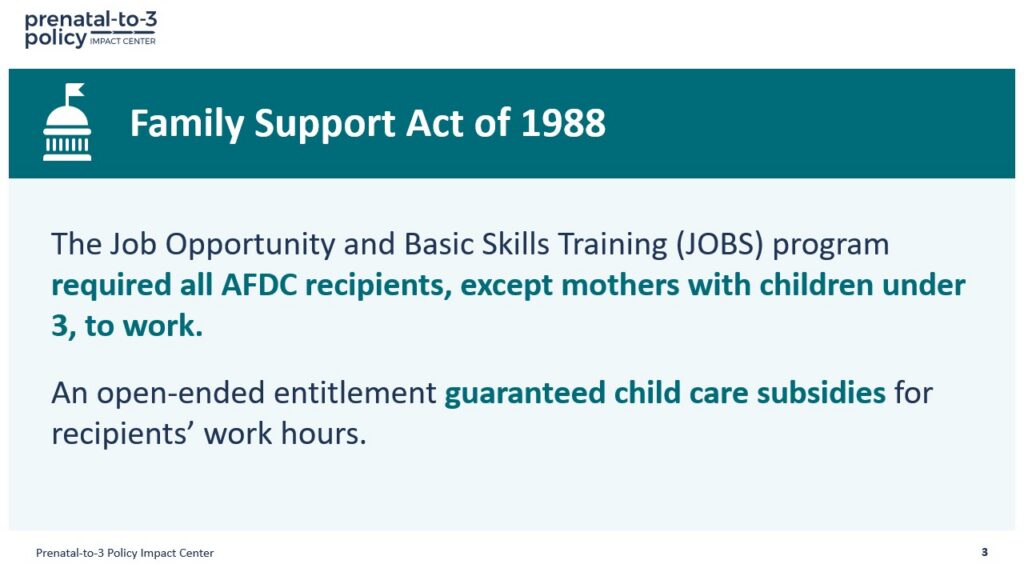
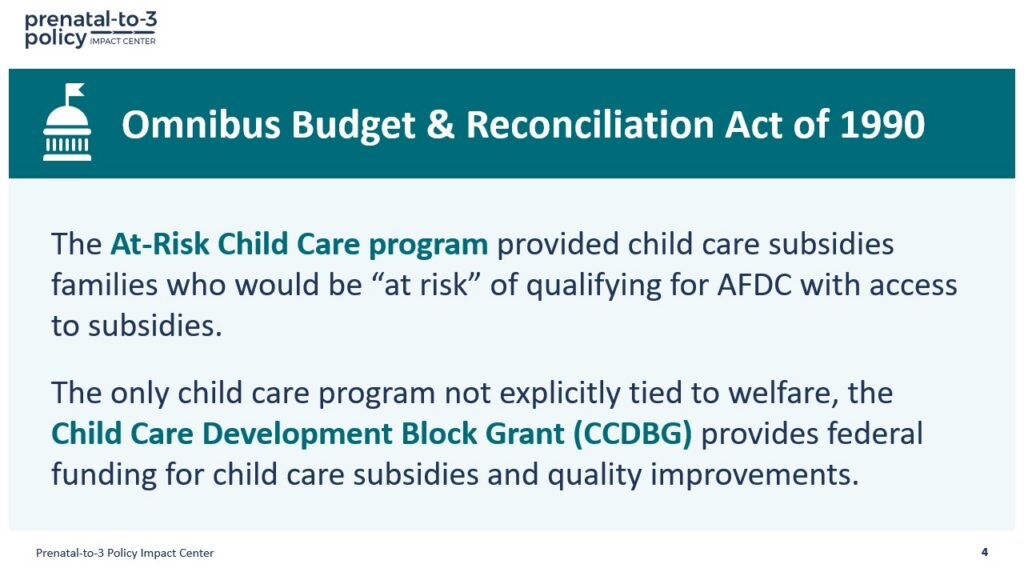
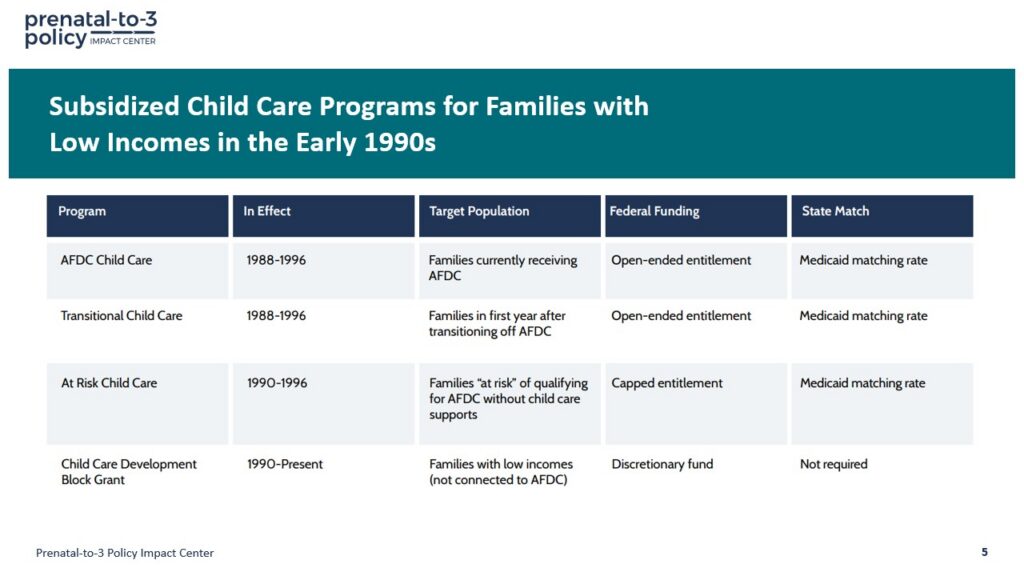
Research found that the work-based programs did increase welfare recipients’ employment and earnings. Nonetheless, the jobs were neither long lasting nor high paying; because welfare payments decreased as recipients’ income increased, recipients struggled to meaningfully increase their net earnings.
Welfare Reform Separates Cash Assistance from Child Care Subsidies
In the 1990s, welfare reform was a top priority for both political parties. The current system was costly to the federal government, and families with low incomes struggled to navigate the fragmented programs. The passage of the Personal Responsibility and Work Opportunity Reconciliation Act (PRWORA) of 1996 overhauled welfare, ushering in the system still used today.
Under PRWORA, child care was separated from cash assistance by establishing the Child Care and Development Fund (CCDF) and the Temporary Assistance for Needy Families (TANF) block grants, respectively.
The CCDF consolidated funding for child care assistance into two streams, the Child Care Development Block Grant (CCDBG) and the Child Care Entitlement to States (CCES); the CCES combined the three child care programs previously associated with welfare. As before, states receive both mandatory and matching funds (see Figure 3).
Figure 3. Funding Streams in Child Care and Development Fund Block Grant
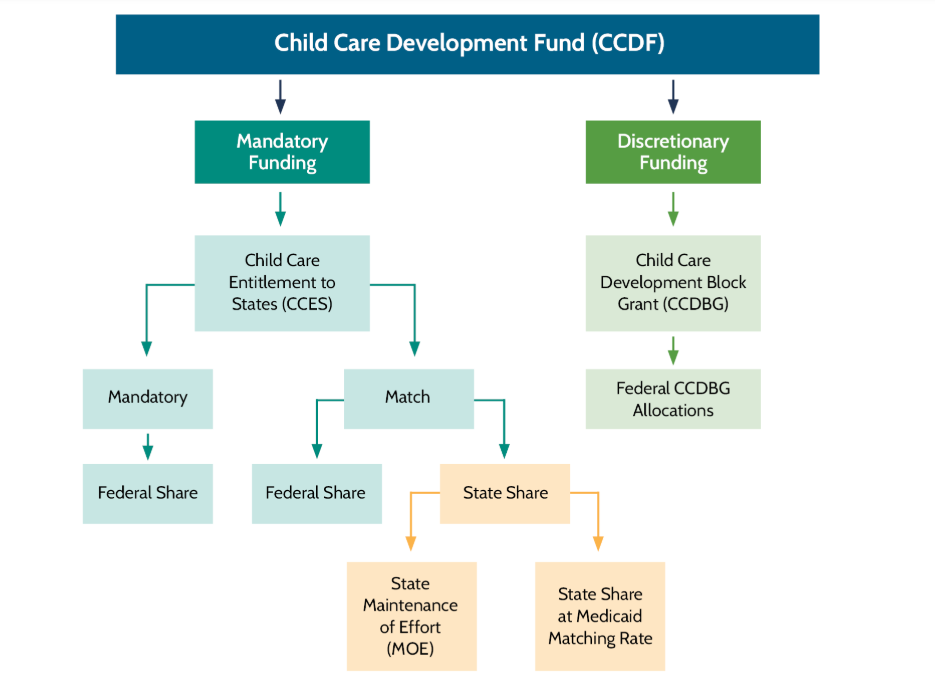
As a block grant, the CCDF provides states with significant control in terms of eligibility, copays, and reimbursement rates, making it difficult to provide oversight and assess effectiveness of subsidy programs. Additionally, unlike entitlements, which are more responsive to macroeconomic changes, block grants provide a fixed amount of funding and may fail to address increased need. In fact, during the pandemic, Congress had to allocate three rounds of relief funding to the CCDF discretionary fund to stabilize the child care sector.
Child Care Subsidies Remain Inequitable Today

Although CCDF regulations mandate certain policy choices, states continue to have significant latitude in the design and implementation of their subsidized care systems today. This latitude, much like previous child care policies, results in subsidized care policies that maintain barriers to restrict “undeserving” families from accessing child care subsidies; these choices tend to disproportionately affect Black, Hispanic, and Native American families.
Specifically, inequitable choices made at the state level undermine the strength of subsidized care systems. First, families must meet eligibility criteria (including work requirements and income limits) and overcome administrative burdens to successfully apply for subsidies. Families that receive a subsidy may still face significant financial burdens in the form of child care copayments and fees. Child care providers also are likely to experience financial hardship, as subsidies often fail to cover the true cost of providing care and exacerbate already thin profit margins.
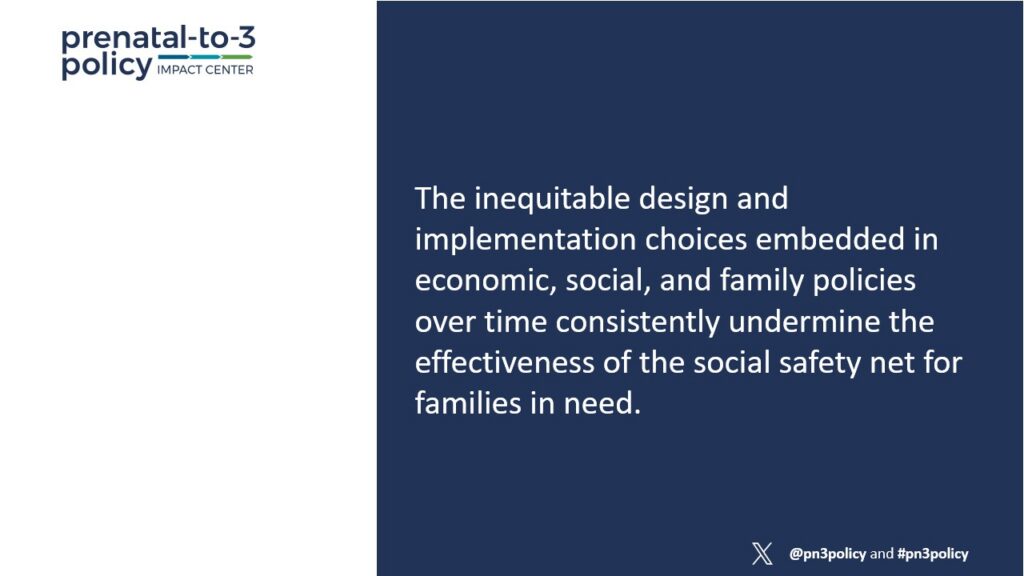
As such, there are still significant opportunities to create a more equitable and just child care subsidy system; in a political environment that prioritizes state control, state leaders have an especially important role to play in ensuring all families can equitably access child care. By critically considering the diffuse, longstanding impact of systemic racism on state policy choices, the design and implementation of subsidized care can become more equitable.
To dive deeper into policy over time and learn more about state-level opportunities to strengthen subsidized child care, check out the full report series.
Note: Reference for statistics and other sources are available in the full report. Please consult the report to identify these original sources.
The History of Child Care Policies
About the Social Policy Histories
This multi-part series presents detailed social policy history reports, complemented by interactive timelines, policy considerations, and history summary tables to highlight patterns of inequity across public support systems and provides insight for more accessible, effective policies.