Preliminary research suggests guaranteed right to counsel in eviction proceedings is a promising policy to improve child and family outcomes.
Rigorous studies have identified several benefits, including increased legal representation, reductions in evictions and eviction-related debt, and improvements in select birth outcomes.
Only three states, Connecticut, Maryland, and Washington, have categorical right to counsel in eviction proceedings. These policies are relatively recent, with the first implemented in Washington in 2021. In several other states, access to counsel in eviction proceedings is more limited or discretionary.

Access the full Guaranteed Right to Counsel in Eviction Proceedings research brief
What Is Guaranteed Right to Counsel in Eviction Proceedings?
Each year, millions of families with children face eviction, with disproportionate rates of single mothers and Black and Native American households affected. Eviction sets off a cascade of negative outcomes including homelessness, long-term housing instability, financial strain, food insecurity, adverse birth outcomes, and disrupted schooling.
A guaranteed right to counsel in eviction proceedings requires that tenants facing eviction have access to legal representation, similar in principle to the right to an attorney in criminal cases.1 In the United States, eviction proceedings are civil matters and tenants are generally not entitled to legal representation unless provided by statute or local policy, leaving those who seek counsel to incur the associated costs.
Legal representation in eviction court is highly unequal. Nationally, approximately 84 percent of landlords are represented by counsel, whereas only approximately 4 percent of tenants have legal representation.1 This imbalance has substantial implications for case outcomes, particularly given the speed, complexity, and procedural requirements of eviction courts. Right to counsel policies aim to reduce this imbalance by guaranteeing full legal representation for eligible tenants, most often those with low incomes, during eviction proceedings.2
This policy primarily addresses court-based evictions, though some programs extend support to pre-filing notices and the policy may reduce overall filings. Unlike formal evictions that proceed through the courts, informal evictions, which are more common, occur when landlords force tenants to leave without using the legal eviction process.i
Eviction is not the only civil context in which right to counsel policies have emerged. A growing movement across the US advocates for counsel funded by city or state governments in other areas as well, such as family law (domestic violence, custody, and child support) and child welfare. Although eviction programs are among the most studied, broader efforts reflect a growing recognition that legal representation can shape outcomes in civil cases with substantial consequences for child wellbeing and family stability.3
i In informal evictions, landlords may use actions such as applying pressure to vacate, changing locks, or shutting off utilities. These evictions often target low-income tenants or immigrants, capitalizing on unequal access to legal information.
Overview of the Eviction Process in the US
Eviction proceedings follow a similar structure across states, although timelines and legal standards vary. First, a landlord must provide a tenant with formal written notice before filing a court case.4 Written notices vary by the reason for eviction (non-payment, lease violation, or no-cause) and the notice period (the amount of time a tenant has to respond). Many potential evictions are resolved at this stage if tenants can pay, remedy the violation, or negotiate.
If the tenant does not comply with the notice, the landlord may file an eviction lawsuit.4 This filing initiates a formal court case and creates a public record. Tenants must then be officially served with court documents, including a summons and complaint. Improper service (not being formally notified of a lawsuit according to legal rules) is a common legal defense but frequently goes unraised by unrepresented tenants.
Tenants typically have a very short period, often only 3-5 days, to respond.4 Only some tenants can secure a lawyer during this time. Failure to file a response generally results in a default judgment for the landlord. If the tenant responds, the court holds a hearing or trial at which both parties present evidence.
Right to counsel laws typically require attorneys connect with clients for the first time no later than the tenant’s first scheduled court appearance; representation is particularly influential here, as eviction law involves technical defenses and procedural rules.5 Within the short response window and in attending court, tenants may face practical barriers including lack of child care or transportation and work obligations.6
Outcomes may include:
- Dismissal – the case is terminated before a verdict is reached,
- Tenant victory – tenants are allowed to remain in the home,
- Landlord victory – the landlord is granted possession, or
- Settlement – both parties negotiate an agreement, often involving a repayment plan or an agreement for the tenant to move out by a certain date in exchange for dropping the case.
If the result is a landlord victory, the court may issue a judgment for possession, sometimes accompanied by a monetary judgment for unpaid rent or fees. If the tenant does not vacate, the landlord can request a writ of possession, authorizing law enforcement to carry out a physical eviction.4
Why Should Guaranteed Right to Counsel in Eviction Proceedings Be Expected to Benefit Children and their Families?
Safe and stable housing is foundational to health, development, and economic stability throughout life. This is particularly the case during early childhood. However, across the US, approximately 2.9 percent of children ages 0 to 3 are homeless, which equates to 446,696 children.7,8,9 Housing instability, including difficulty paying rent, overcrowding, frequent moves, or spending a disproportionate share of income on housing, is recognized as a social determinant of health.10
Housing affordability pressures have intensified over the past 2 decades. Since 2000, inflation-adjusted housing prices have increased by approximately 65 percent, whereas median household income has grown only modestly.11 As a result, many families with young children face severe rent burdens. Families experiencing homelessness or unstable housing are also more likely to be involved in the child welfare system.12
Housing instability affects parents as well. The stress of potential eviction or homelessness can exacerbate parental mental and physical health challenges, strain family relationships, and interfere with employment through lack of a stable address, transportation difficulties, or limited access to child care.8,13,14
Eviction often represents the first event among many adverse outcomes. Households facing eviction are at heightened risk of homelessness, longterm housing instability, financial strain, food insecurity, and adverse birth outcomes.15,16,17 Among children, research has shown evictions result in interruptions in school engagement.18
Filings may also affect future housing access and credit scores.19 Evictions do not trigger ineligibility for public housing access, however access can still be significantly hindered during the several years the eviction record appears on screening reports. Many landlords also screen applicants based on prior records. Evictions can damage credit through financial consequences, such as rent fees sent to collection agencies. Beyond the impacts on individuals and families, evictions are costly to communities because of the need for homeless shelters, emergency medical care, and foster care for children.

Risks are not evenly distributed. Families with children19, particularly single mothers with children, victims of domestic violence, and Black and Native American20 families, experience disproportionately high eviction rates, housing cost burdens, and exposure to poor housing conditions. These disparities reflect longstanding structural inequities and discriminatory housing policies. Nuisance laws, which prohibit interference with a person’s use and enjoyment of their property (e.g., through ongoing noise), can increase eviction risks for victims of domestic violence because calling the police may trigger enforcement of these laws.19 An estimated 5.7 percent of all children ages 0 to 4 living in renting households are evicted each year.21 For Black children ages 0 to 4, this increases to 12.4 percent.
Studies show that between 51 and 75 percent of tenants without legal
representation lose their cases in court, whereas around 67 percent of
tenants with full representation can remain in their homes.1 By improving tenants’ ability to navigate eviction proceedings, guaranteed right to counsel policies may help families avoid eviction, stabilize housing arrangements, and reduce stress during critical developmental periods, including pregnancy and early childhood.
What Impact Does Guaranteed Right to Counsel in Eviction Proceedings Have, and for Whom?
Right to counsel in eviction is a relatively recent policy intervention. New York City was the first US jurisdiction to enact a right to counsel law for tenants facing eviction, adopting its Universal Access to Counsel (UAC) program in 2017.5 The program guarantees legal representation for tenants with incomes below 200 percent of the federal poverty level and provides legal advice (but not full representation) to higher-income tenants.
UAC was implemented gradually by zip code, prioritizing neighborhoods with high eviction rates and low tenant representation.5 This staggered rollout created a natural experiment that enabled rigorous evaluation.
Legal Representation
A 2023 study examining UAC found that tenant representation increased substantially in zip codes where right to counsel was implemented. Between 2016 and 2019, tenant representation increased from 21.7 percent to 38.5 percent in zip codes where the UAC program was implemented, while representation slightly declined in areas without access (from 20.1% to 19.7%).5 Exploiting the staggered implementation of the policy across zip codes, the authors show that the resulting divergence in representation rates was statistically significant.
Legal Outcomes
The same study found that access to right to counsel reduced the probability a judgment for possession was issued (where the final judgment grants the landlord possession) by 31.3 percentage points.5 It also reduced the probability that a warrant of eviction (writ of possession) was issued by 34.9 percentage points. Finally, right to counsel reduced the probability that a warrant was executed, meaning the eviction was physically carried out by law enforcement, by 11.3 percentage points. These outcomes reflect successive stages of the eviction process, as a judgment for possession is required before a warrant of eviction can be issued, and only a subset of issued warrants are ultimately executed.
Access to counsel also led to improved financial outcomes for tenants. The final monetary amount awarded to landlords declined by approximately $276 (January 2021 dollars).5 Although not all monetary judgments are ultimately collected, such debts can be sent to collections and contribute to longer-term financial instability.
Birth Outcomes
A 2024 study examined birth outcomes among infants born to Medicaid-insured mothers in New York City. Right to counsel access throughout pregnancy led to a 0.73 percentage-point reduction in low birthweight and a 0.91 percentage-point reduction in preterm birth.22 There were not statistically significant impacts on very preterm birth, gestational age, or average birthweight. These findings suggest that housing-related legal protections during pregnancy may reduce stressors that contribute to adverse birth outcomes.
How Does Guaranteed Right to Counsel in Eviction Proceedings Vary Across States?
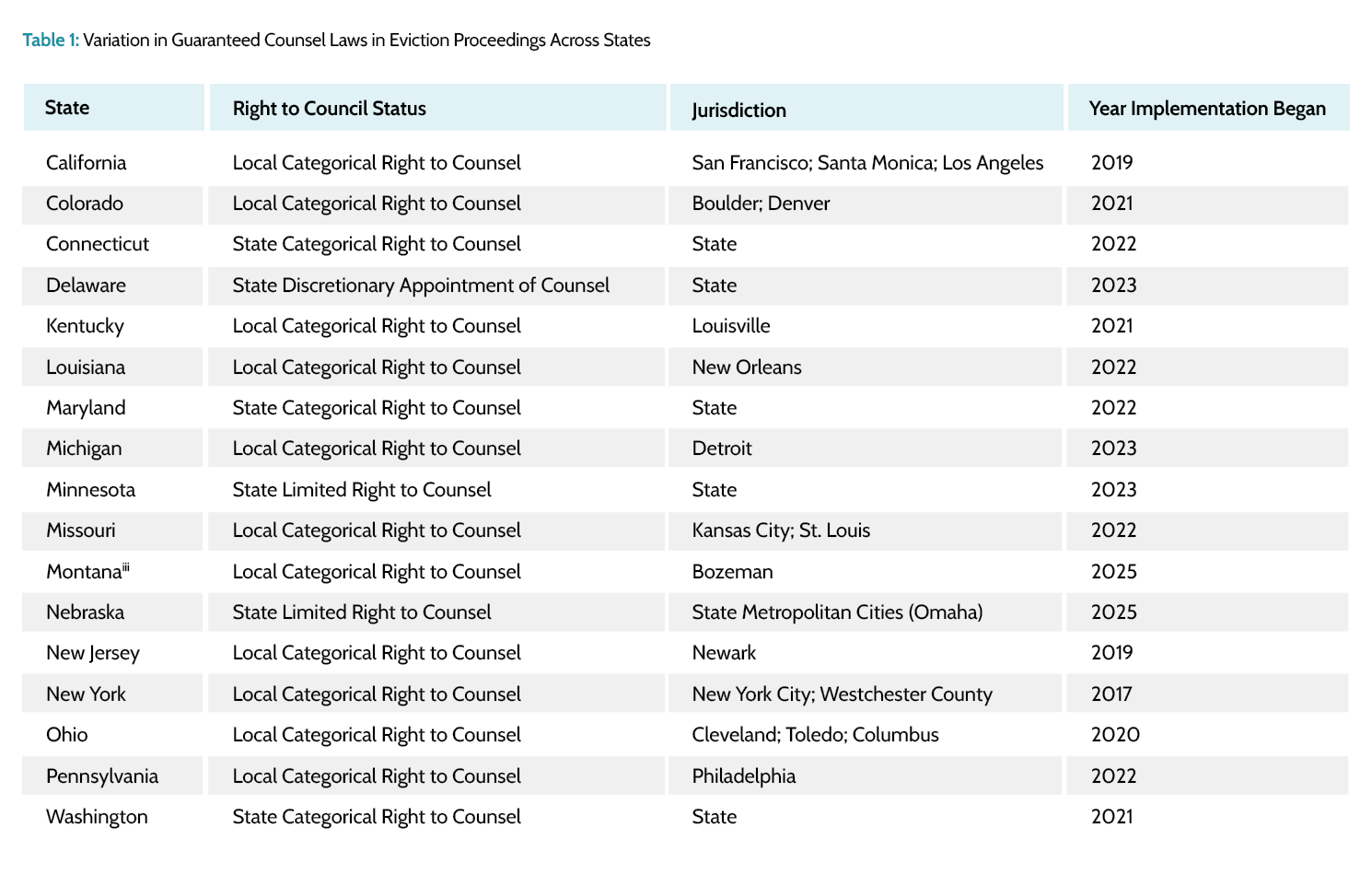
As of February 2026, only three states, Connecticut, Maryland, and Washington, have implemented statewide categorical right to counsel laws for tenants facing eviction.23
Eligibility criteria vary across these states: tenants qualify if income is below 80 percent of the area median income in Connecticut, 50 percent of the median income (adjusted for household size) in Maryland, or 200 percent of the federal poverty level or enrollment in certain public assistance programs in Washington.
Other states have implemented more limited or discretionary approaches to providing access to counsel, often restricted to specific cities or subject to case-by-case determinations. Most of these policies include income eligibility thresholds. Table 1ii summarizes the variation across the 17 states that have some form of right to counsel policy in effect as of February 2026.23
ii In Massachusetts in 2017, a judge ruled that appointing counsel in eviction proceedings protects tenants’ rights under federal and state constitutions, however, no program was created or funding allocated. Massachusetts has also funded a statewide pilot program, and Boston has funded a city pilot program, however, these are not considered as right to counsel laws. Massachusetts is therefore excluded from Table 1.
iii In December 2025, the city of Bozeman enacted a right to counsel law for all tenants, with priority for those with children, elderly individuals, multi-generational households, and those with disabilities. Although the law is enacted, there are no updates on the implementation yet.
What Other State-Level Tenant Protections May Benefit Children and Their Families?
In addition to right to counsel policies, states and localities have adopted a range of tenant protections that may affect housing stability for families.24,25,26
These policies are generally less studied than right to counsel in eviction proceedings. Examples include:
- Capping rent increases by linking them to inflation, which protects tenants from drastic rent increases,
- Limiting the size of security deposits, which reduce upfront barriers to securing housing,
- Implementing “just cause” eviction laws, which restrict landlords’ ability to evict tenants without a legally defined reason,
- Implementing policies to seal eviction records, which limit public access and may improve tenants’ ability to secure future housing, and
- Restricting evictions during the academic year through school-year eviction moratoriums, which protect households with children from eviction for nonpayment of rent between September and June.
Conclusion
Emerging evidence from New York City suggests that guaranteed right to counsel in eviction proceedings meaningfully benefits legal and financial outcomes, as well as infant health.
At the same time, the evidence base remains small and geographically concentrated. Future research, that is methodologically strong and allows for causal inference, is needed to assess the impacts of statewide policies, variation in program design, and the quality of legal representation. Given the well-documented negative impacts of eviction and housing instability for children and families, guaranteed right to counsel represents a promising, although still evolving, policy approach.
Guaranteed Right to Counsel in Eviction Proceedings
About The Data
Brief prepared by Anna Thom. State variation data prepared by Cory Worrall.
Recommended Citation
Prenatal-to-3 Policy Impact Center (2026). Guaranteed Right to Counsel in Eviction Proceedings: A Promising Policy to Improve Child Outcomes. Peabody College of Education and Human Development. Vanderbilt University. https://pn3policy.org/
Citations
- National Coalition for a Civil Right to Counsel. (2026). Eviction representation statistics for landlords and tenants absent special intervention. https://civilrighttocounsel.org/wp-content/uploads/2023/11/Landlord_and_tenant_eviction_rep_stats__NCCRC_.pdf
- Keene, D. E., Olea Vargas, G., & Harper, A. (2024). Tenant right to counsel and health: Pathways and possibilities. SSM. Qualitative Research in Health, 6, Article 100464. https://doi.org/10.1016/j.ssmqr.2024.100464
- Schultheis, H., & Rooney, C. (2019). A right to counsel is a right to a fighting chance. Center for American Progress. https://www.americanprogress.org/article/right-counsel-right-fighting-chance/
- National Low Income Housing Coalition. (2022). Evictions 101: The eviction process: How it works and what to know. https://nlihc.org/resource/evictions-101-eviction-process-how-it-works-and-what-know
- Cassidy, M., & Currie, J. (2023). The effects of legal representation on tenant outcomes in housing court: Evidence from New York City’s Universal Access program. Journal of Public Economics, 222, Article 104844. https://doi.org/10.1016/j.jpubeco.2023.104844
- County Health Rankings & Roadmaps. (n.d.). Legal support for tenants in eviction proceedings. https://www.countyhealthrankings.org/strategies-and-solutions/what-works-for-health/strategies/legal-support-for-tenants-in-eviction-proceedings
- Singh, S. (2024). How housing instability affects children’s health and development. Housing Matters, Urban Institute. https://housingmatters.urban.org/articles/how-housing-instability-affects-childrens-health-and-development
- Rollings, K. A., Wells, N. M., Evans, G. W., Bednarz, A., & Yang, Y. (2017). Housing and neighborhood physical quality: Children’s mental health and motivation. Journal of Environmental Psychology, 50, 17–23. https://doi.org/10.1016/j.jenvp.2017.01.004
- SchoolHouse Connection. (2025). Infant & toddler homelessness across 50 states: 2022-2023. https://schoolhouseconnection.org/article/infant-and-toddler-homelessness
- U.S. Department of Health and Human Services, Office of Disease Prevention and Health Promotion. (n.d.). Housing instability. Healthy People 2030. https://odphp.health.gov/healthypeople/priority-areas/social-determinants-health/literature-summaries/housing-instability
- Feiveson, L., Levinson, A., & Schreiner Wertz, S. (2024). Rent, house prices, and demographics. U.S. Department of the Treasury. https://home.treasury.gov/news/featured-stories/rent-house-prices-and-demographics
- Dworsky, A. (2014). Understanding the relationship between housing and child welfare system involvement. Chapin Hall at the University of Chicago. https://www.chapinhall.org/research/understanding-the-relationship-between-housing-and-child-welfare-system-involvement/
- Glomm, G., & John, A. (2002). Homelessness and labor markets. Regional Science and Urban Economics, 32(5), Article 0166. https://doi.org/10.1016/S0166-0462(01)00097-7
- Newman, S., Leventhal, T., Holupka, C. S., & Tan, F. (2024). Experimental Evidence Shows That Housing Vouchers Provided Measurable Benefits, Including Parent Stress Reduction: Study examines effect of housing vouchers on health and families. Health Affairs, 43(2), 278–286. https://doi.org/10.1377/hlthaff.2023.01020
- Collinson, R., Humphries, J. E., Mader, N., Reed, D., Tannenbaum, D., & van Dijk, W. (2024). Eviction and Poverty in American Cities. The Quarterly Journal of Economics, 139(1), 57–120. https://doi.org/10.1093/qje/qjad042
- Leifheit, K. M., Schwartz, G. L., Pollack, C. E., Black, M. M., Edin, K. J., Althoff, K. N., & Jennings, J. M. (2020). Eviction in early childhood and neighborhood poverty, food security, and obesity in later childhood and adolescence: Evidence from a longitudinal birth cohort. SSM – Population Health, 11, Article 100575. https://doi.org/10.1016/j.ssmph.2020.100575
- Himmelstein, G., & Desmond, M. (2021). Association of Eviction With Adverse Birth Outcomes Among Women in Georgia, 2000 to 2016. JAMA Pediatrics, 175(5), 494–500. https://doi.org/10.1001/jamapediatrics.2020.6550
- Collinson, R., Dutz, D., Humphries, J. E., Mader, N., Tannenbaum, D. I., & van Dijk, W. (2025). The Effects of Eviction on Children. SSRN Electronic Journal. https://doi.org/10.2139/ssrn.5215969
- Desmond, M. (2017). Evicted : poverty and profit in the American city / Matthew Desmond (First edition). Broadway Books, an imprint of the Crown Publishing Group, a division of Penguin Random House LLC.
- Hepburn, P., Louis, R., & Desmond, M. (2020). Racial and Gender Disparities among Evicted Americans. Sociological Science, 7(27), 649–662. https://doi.org/10.15195/v7.a27
- Graetz, N., Gershenson, C., Hepburn, P., Porter, S. R., Sandler, D. H., & Desmond, M. (2023). A comprehensive demographic profile of the US evicted population. Proceedings of the National Academy of Sciences – PNAS, 120(41), Article e2305860120. https://doi.org/10.1073/pnas.2305860120
- Leifheit, K. M., Chen, K. L., Anderson, N. W., Yama, C., Sriram, A., Pollack, C. E., Gemmill, A., & Zimmerman, F. J. (2024). Tenant Right-to-Counsel and Adverse Birth Outcomes in New York, New York. JAMA Pediatrics, 178(12), 1337–1344. https://doi.org/10.1001/jamapediatrics.2024.4699
- National Coalition for a Civil Right to Counsel. (n.d.). Right to Counsel Activity / Status Map. https://civilrighttocounsel.org/map/
- Urban Institute. (n.d.). “Just cause” eviction laws. Pursuing housing justice: Interventions and their impact. https://www.urban.org/apps/pursuing-housing-justice-interventions-impact/just-cause-eviction-laws
- National Low Income Housing Coalition. (2023). The state of statewide tenant protections. https://nlihc.org/sites/default/files/The-State-of-Statewide-Tenant-Protections.pdf
- Renting in Seattle. (n.d.). Defenses to eviction. City of Seattle. https://www.seattle.gov/rentinginseattle/housing-providers/moving-a-tenant-out/defenses-to-eviction