For all working parents, the arrival of a new child necessitates time away from work – giving birth requires physical recovery and parents need time to focus on bonding with their new child. Although this reality applies to all parents, the ability to take time away from work to do so – and access to paid leave while away – remains inaccessible for many. Black, Hispanic, and Native American families are less likely to have access to paid leave than their White counterparts, and less often able to afford unpaid leave when that is the only option.
Although employment protections under the law began in the early 1900s, there were no federal protections from pregnancy discrimination in the workplace until 1978. Only in 1993 did unpaid, job-protected family and medical leave become available to part of the workforce. In the absence of federal action, state policy remains the main driver of paid family leave, beginning in 2004 when California fully implemented a program to cover all new parents.
As more and more states explore paid leave policies, leaders have the opportunity to design these policies in more equitable ways—which begs the question: how did we get here?

Access the full History of Paid Family Leave Policies
Racism and Sexism Shape Early and Ongoing Political Context
The foundation of what is now the United States of America was heavily influenced by the dominant ideologies of White supremacy, colonialism, and patriarchy. In the earliest days of our country, land was forcibly taken from Native populations, Black individuals were enslaved, and women were typically the property of male family members, all of which set the initial context for work and family policies in the nation’s early history. Although chattel slavery officially ended in 1865, racial caste systems remained in place. Black individuals (especially men) gained rights following the ratification of the 13th, 14th, and 15th Amendments. Following this expansion of rights, new policies like the Jim Crow laws in the south were enacted to restrict rights, marking one example of a pattern of progressive action to be followed by regressive action seen in subsequent policy making.
Labor Protections Expanded in the Early 1900s, but Access Was Limited
Few Labor Protections Existed in the Early 1900s, Patterns of Segregation Persisted
In the early 1900s, approximately one in five women in the US participated in the paid labor force, though participation differed greatly by race. By the 1920 Census, 21.9 percent of White women and 43.8 percent of Black women were recorded as “gainfully employed.” Trends in workforce participation at this time were shaped by disparate ideas of who should and must work; women of color and women with lower household resources often had to work to provide for their families, while White women, particularly those with higher socioeconomic statuses, were not expected to work.
Labor Force Participation by Race and Marital Status, 1930-2010
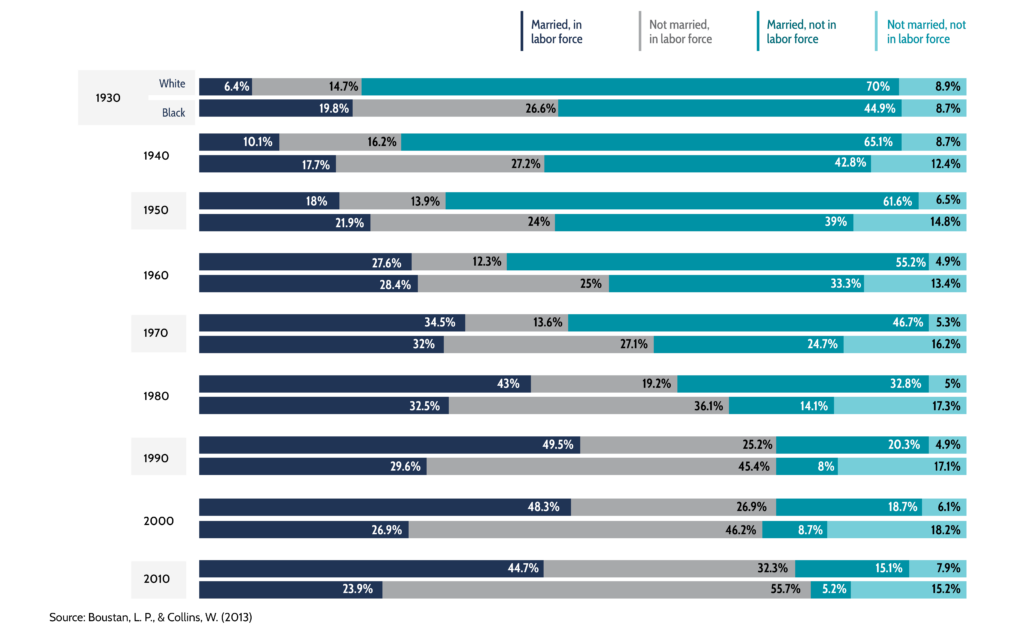
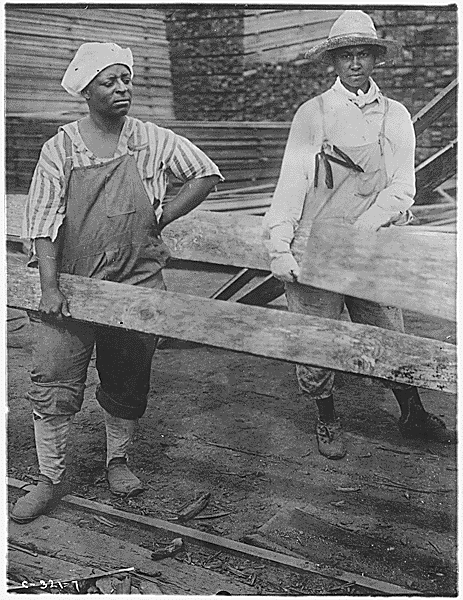
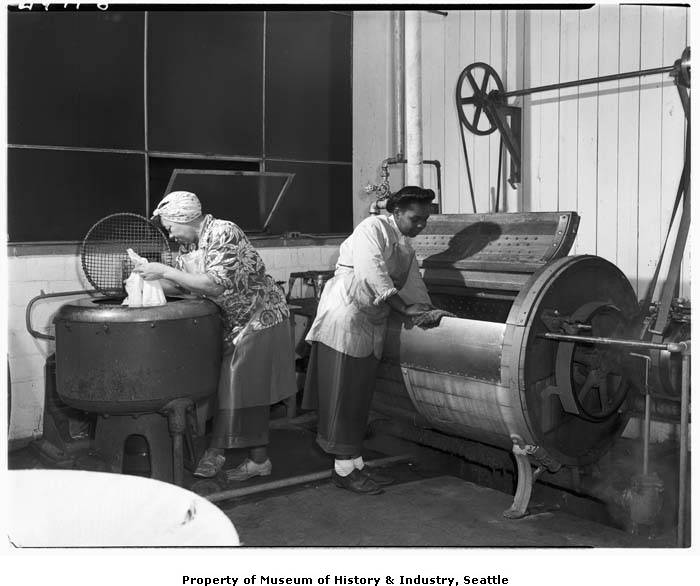
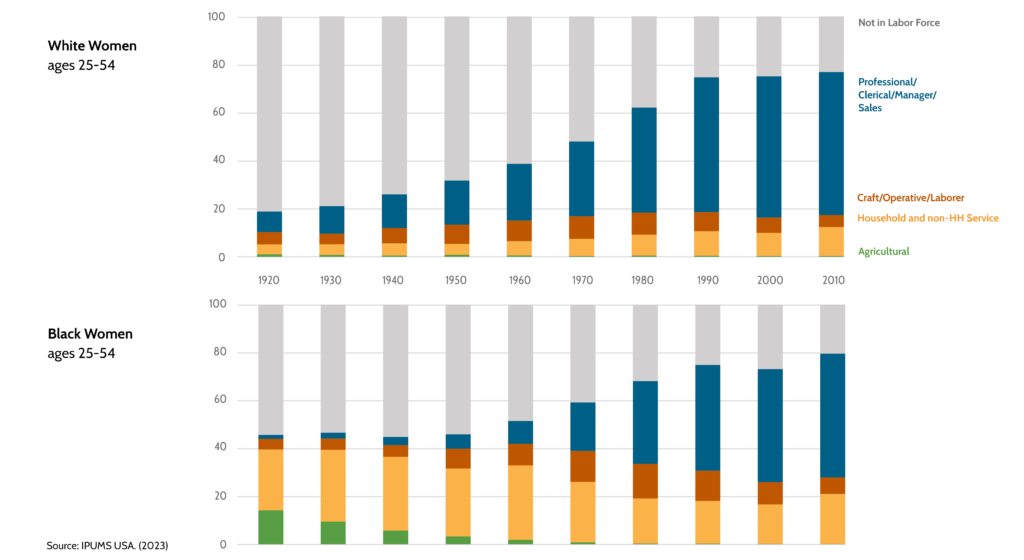
Although women’s overall labor force participation increased in the early 1900s, patterns of occupational segregation remained. People of color were often only able to access work in jobs that provided lower wages and lacked workplace protections. For example, in 1930, Black women were much more likely to work in agricultural, household service, or other service positions than white women. Patterns of occupational segregation reproduced inequities (e.g., lower wages perpetuate a wealth gap).
Labor Force Participation and Occupational Distribution by Race, 1920-2010
Early Worker Protections Excluded Workers of Color
While women’s formal labor force participation was increasing, federal employment policy began undergoing changes and worker protections were expanded. In 1935, Congress enacted the National Labor Relations Act (Wagner Act), which provided workers the right to unionize and seek better working conditions. Three years later, Congress enacted the Fair Labor Standards Act (FLSA, 1938), which set a national minimum wage, created the 40-hour work week, and restricted child labor. However, both the Wagner Act and FLSA originally excluded agricultural and domestic service workers, occupations in which Black workers were concentrated.
Worker Protections Were Expanded Decades Later to Be More, but Not Fully Inclusive
Several decades later, in the 1960s and 1970s, workforce protections expanded again – protections previously extended to occupations that were predominantly filled by White workers were extended to those in which women and people of color were more likely to work. A series of amendments to the FLSA took incremental steps to expand access to critical employment protections:
- 1961: Expanded covered industries to include retail trade and construction, raised the minimum wage; however, employees in newly covered industries were 90% White, limiting the impact for workers of color.
- 1963: The Equal Pay Act prohibited paying different wages for the same job on the basis of sex, giving women the opportunity to receive “equal pay for equal work.”
- 1967: Expanded covered industries to include workers on large farms, those working for schools, hospitals, nursing homes, and other previously excluded service industries; impacting nearly one-third of Black workers resulting in higher wages and shrinking the wage gap.
- 1974: Expanded covered industries to include government and domestic service workers (an occupation that was majority women of color) and raised the minimum wage for nonfarm workers.
Employment Protections for Pregnancy and Childbirth Were First Federally Passed in the 1960s
In the same period, Congress enacted landmark legislation such as Title VII of the Civil Rights Act of 1964, which prohibited discrimination based on race, color, religion, sex, or national origin. In 1978, the Pregnancy Discrimination Act amended Title VII of the Civil Rights Act to specify that pregnancy discrimination was a form of sex discrimination.
Both pieces of legislation were monumental legal changes for workers of color and women, strengthening employment protections, creating better access to a range of occupations, and extending policies like disability insurance provided by states to include pregnancy and child birth, a foundational component of later paid family leave policies.
Federal Legal Protections for Leave Related to Family and Medical Needs Were Established Only a Few Decades Ago
Legislation specific to the need for extended family and medical leave did not appear at the federal level until the 1980s, culminating in the passage of the Family and Medical Leave Act (FMLA) in 1993. In its final form, the FMLA required the provision of 12 weeks of unpaid, job-protected leave for eligible employees who have serious health conditions, need to care for sick family members, and/or take care of new children (by birth, adoption, or foster care), though these protections were only extended to certain employers and employee’s meeting work tenure requirements.
As a result, workers with low-incomes and in less stable jobs (e.g., may work multiple part-time jobs), who were more likely to be people of color, were often ineligible for FMLA or less able to afford unpaid leave. The final FMLA policy was much less general than earlier iterations, with expanded exemptions for small businesses and a shorter duration of leave.
In The Absence of Federal Paid Leave Policy, States Led Policy Implementation
Given the absence of federal paid parental leave, states have had to step in. In 2002, California became the first state to enact a statewide paid family and medical leave program that extended leave access to non-birthing parents. In the last decade, state implementation of statewide paid family and medical leave program has grown substantially.
As of January 2026, 11 states and the District of Columbia have fully implemented statewide paid family and medical leave programs. Two additional states are in the process of implementing programs. However, there is significant variation in the design and implementation of state paid family leave policies that have important implications for who is eligible for paid family leave and can afford to use the program as needed.
Policies of Exclusion Tied to Labor and Parenthood Drive Present-Day Policy
Our full history further demonstrates how race and poverty have continuously been used as justification for policies of exclusion tied to labor and parenthood and how policies of the past continue to drive present-day policy. To dive deeper into policy over time and learn more about state-level opportunities to strengthen paid family leave (PFL) programs, check out the full report series.
Note: References for statistics and other sources are available in the full report. Please consult the report to identify these original sources.
The History of Paid Family Leave Policies
About the Social Policy Histories
This multi-part series presents detailed social policy history reports, complemented by interactive timelines, policy considerations, and history summary tables to highlight patterns of inequity across public support systems and provides insight for more accessible, effective policies.