Introduction
Download the full brief to explore what the data reveal about home-based child care supply and provider experiences across greater Davidson County. Understanding this often-overlooked segment of the local child care system is essential to building a more complete and responsive child care landscape for all families.
High-quality child care is an essential resource for families and children. Reliable child care enables parental workforce participation, simultaneously providing children with a safe, nurturing, and structured environment that promotes healthy development.1 Quality child care also strengthens families’ economic stability, which improves child developmental outcomes and promotes broader economic growth.2
Despite the essential need for child care, families across the United States face challenges accessing or affording it.3 Understanding the structure and availability of different types of child care in the greater Davidson County region provides context for assessing gaps in child care access locally.
In Davidson County, TN, which includes the capital city of Nashville, center-based and home-based programs are the two primary types of licensed child care offered to the approximately 39,900 local children under age 5 in households in which all parents work.4 Families have varied preferences for child care settings, and both center- and home-based child care play essential roles in meeting diverse needs and preferences.5 Though both program types support family wellbeing and children’s development, they differ in structure, capacity, and overall availability.
Home-based child care represents an exceedingly small share of licensed child care programs in the region, but remains an important component of the local child care landscape. To best support greater Davidson County’s home-based child care programs, localized data are needed to understand the unique strengths and challenges of the local home-based child care system.
To learn about home-based child care in greater Davidson County, the Prenatal-to-3 Policy Impact Center (Policy Impact Center) at Vanderbilt University developed and fielded a survey to all licensed child care programs in the region during the Summer of 2025. Of the 29 licensed home-based programs, 14 responded to the Davidson County Child Care Provider Experience Survey (Child Care Provider Survey) and provided sufficient information for our descriptive analyses. Together, these 14 responses, though too few to facilitate population-level conclusions, provide important insights into the supply of home-based child care and the experiences of licensed home-based child care programs in the greater Davidson County region.a
This brief examines the licensed home-based child care system in greater Davidson County and is the third part of a five-part series presenting the findings of the Davidson County Child Care Landscape Study.
Background
Home-based child care is vital to the early care and education ecosystem. Home-based child care offers flexibility, affordability, and cultural alignment with the children and families home-based providers serve.6 Many families with infants and toddlers prefer home-based child care options because of home-based providers’ ability to offer a more intimate and flexible environment.7 Home-based child care programs often have unique strengths, such as small group sizes, consistent caregiver-child relationships, and flexible hours, that support both healthy child development and parental employment.8
In greater Davidson County, however, licensed home-based child care represents a very small portion of the overall supply of licensed child care slots. The region has just 29 licensed home-based child care programs with a combined maximum capacity of 317 child care slots (per state licensing regulations), representing approximately one percent of local licensed child care slots.
Under Tennessee Department of Health and Human Services (TDHS) state licensing regulations, home-based programs are categorized as either family or group home-based child care programs.b Family- and group-home-based programs differ in program size and the staffing needs that follow. Family home-based child care programs serve up to seven children, whereas group home-based programs serve at least eight and up to 15 children and often employ at least one additional educator to meet regulatory and quality standards.9
Despite differences in size, both family and group home-based programs follow similar operational practices, offer comparable environments, and serve families in much the same way. Therefore, this brief discusses all home-based child care programs collectively.
The following findings share insights into the characteristics and experiences of licensed home-based child care programs in greater Davidson County.
a To review the complete methodology and approach for the Davidson County Child Care Landscape Study, see our online Methods Appendix.
b Out of the 29 licensed home-based providers in greater Davidson County, 23 are group home-based programs, 10 (43%) of whom responded to the survey. Six are family home-based programs, four (67%) of whom responded to the survey.
Unlicensed or unregulated home-based child care operations are outside the scope of this study and were not included in the Child Care Provider Survey.
Home-Based Programs Are Operating at 98 Percent of Their Licensed Capacity
Surveyed home-based child care programs in greater Davidson County report operating near their licensed capacity limits, leaving virtually no room to serve additional families seeking licensed home-based child care. To ensure the safety of children and the quality of child care programs, licensing regulations set firm limits on the number of children who may be present in a child care program at any given time.
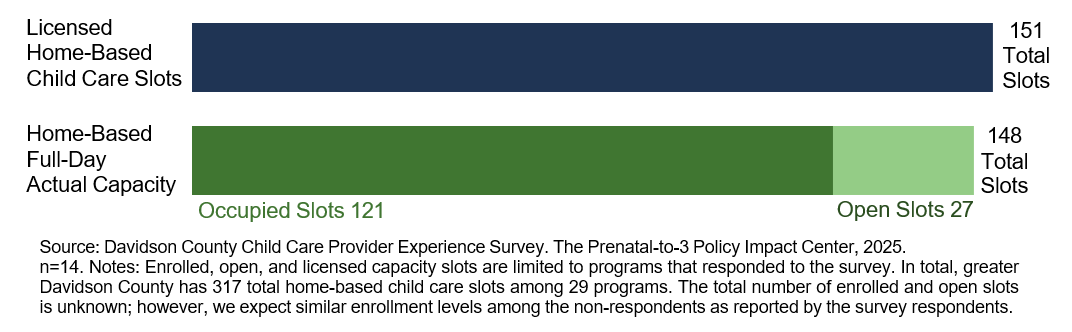
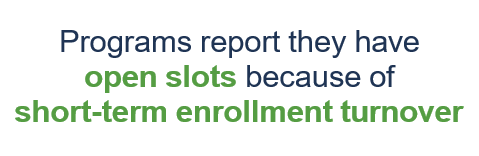
The 14 home-based child care programs that responded to the Child Care Provider Survey have a licensed capacity of 151 child care slots.c Across these programs, directors report that 121 full day-equivalent slots are currently occupied by children under age 5 and that just 27 full-day equivalent slots remain open and available to families seeking licensed home-based child care in the region (see Figure 1).d Importantly, directors most commonly attribute these few open slots to short-term turnover among children, suggesting that these few slots are unlikely to remain open for an extended period of time.
Together, the sum of enrolled and open slots equals the full-day actual capacity among home-based survey respondents, or the total number of full-day equivalent slots that could be occupied today by either one child enrolled full time or multiple children each enrolled part time. Across the responding programs, full-day actual capacity totals 148 child care slots, or almost all (98%) of their collective licensed capacity (see Figure 1).e
Although findings cannot be generalized to all home-based child care programs in greater Davidson County, among these 14 programs, the minimal difference between licensed capacity (151 slots) and full-day actual capacity (148 slots) indicates that programs are operating near their regulatory limits. If similar utilization patterns hold across the remaining 15 licensed home-based programs that did not respond to the survey, then licensed home-based care is likely operating close to full licensed capacity, with exceedingly few open slots available to families seeking licensed home-based care.
Further, the prevalence of waitlists among home-based programs underscores both the limited availability of home-based child care slots and the persistent demand that exceeds current capacity. Among survey respondents, 10 of 14 (71%) report waitlisting or turning away at least one child because of capacity constraints in the past 6 months.
In greater Davidson County, families’ access to home-based child care is limited by a system operating near full licensed capacity. High enrollment, few open child care slots (often not open for long), and persistent waitlists leave virtually no space for new enrollment within existing home-based programs. As a result, current home-based programs cannot meaningfully expand to take on additional children. Meeting excess demand for home-based child care in greater Davidson County would require new home-based child care programs to enter the system.
c The 14 programs in the sample represent 48 percent of all licensed home-based capacity in the region.
d The exact number of open full-day equivalent slots is 26.5, with the .5 indicating an open part time slot. We round this number to 27 for simplicity.
e Full-day actual capacity is typically lower than licensed capacity because in addition to an overall capacity limit, providers are subject to age-group-specific ratio and group size limits depending on the distribution of ages served at the program.
Providers may also simply choose to serve fewer children than their licensed maximum, or may be limited by staffing shortages or other constraints. Because in home-based settings one educator can serve multiple children of varying ages at once, the difference between full-day actual capacity and licensed capacity may be smaller than in other child care settings.
Full-Time Home-Based Child Care Options for Infants Are Particularly Limited
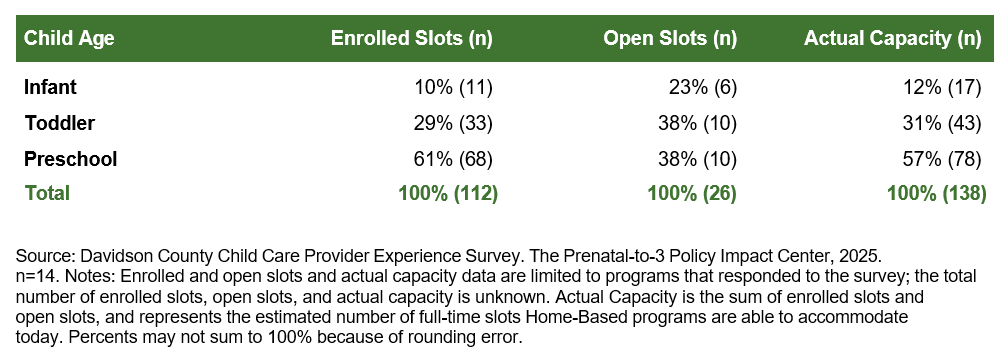
Although many families prefer home-based child care for their infants, the scarcity of infant slots in greater Davidson County’s already limited home-based child care system presents additional challenges to meeting infant care needs.10, 11, 12 Currently, Child Care Provider Survey respondents report that only 11 of the 112 children (10%) enrolled full-time in home-based child care are infants, and just 6 of the 26 (23%) open full-time home-based child care slots are designated for infant care (see Figure 2).f
Of the 138 full-time home-based child care slots occupied by or available to children under age 5 among survey respondents, just 17 (12%) are allocated for infants, compared to 43 (31%) for toddlers and 78 (57%) for preschoolers (see Figure 2).
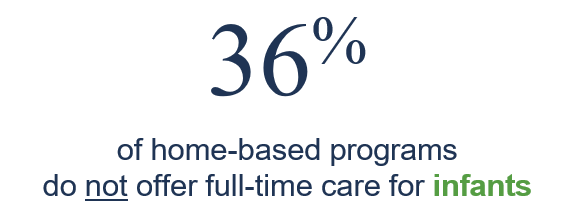
A key factor limiting full-time home-based infant capacity in greater Davidson County is that many home-based child care programs do not serve infants. Of the Child Care Provider Survey respondents, over one-third (36%) of programs report that they do not serve infants at all, whereas almost all (93%) programs report serving toddlers and preschoolers.
 Among the home-based survey respondents who report serving infants, over one-third (38%) indicate that they are unwilling or unable to modify their infant capacity. Across all programs, this means that more than half (57%) of home-based Child Care Provider Survey respondents either do not serve infants or cannot serve more, underscoring the capacity limitations.
Within an already full home-based child care system, infant care is particularly scarce. The extremely limited supply of home-based infant slots may leave many families unable to secure the type of infant care they prefer, perhaps requiring them to accept child care arrangements that do not fully meet their needs and preferences.
Current Directors of Licensed Home-Based Child Care Programs Average More Than 25 Years of Experience in Early Childhood Education
Licensed home-based care in greater Davidson County is very limited; however, among the 14 home-based survey respondents, directors report extensive professional experience. Surveyed home-based program directors average 27 years in early childhood education and 24 years in the director’s position. Most surveyed licensed home-based programs have operated for years, suggesting continuity among providers who have successfully entered and remain in the licensed child care market in greater Davidson County.
Directors also report being financially stable. All 14 home-based Child Care Provider Survey respondents reported breaking even or operating profitably, and almost all directors who responded (90%) reported rarely or never working without pay. Importantly, however, these responses only reflect the perspectives of a group of directors who have successfully entered and remained in the licensed child care market.
Additionally, home-based survey respondents indicate that they find state child care licensing and regulatory processes manageable (9 of 11 respondents). However, these responses only reflect the perspectives of directors who have successfully completed the licensing process and remained in operation. The overall prevalence of unlicensed home-based child care in the region is unknown, and the Child Care Provider Survey does not capture the experiences of prospective providers who may have attempted to become a licensed home-based provider but were unsuccessful. Barriers associated with licensing, startup costs, or regulatory requirements may influence whether new programs enter the greater Davidson County licensed home-based child care market, identifying an area for further inquiry.13
Moreover, the small population of licensed home-based providers and limited information about prospective providers raise a unique conundrum on the long-term sustainability of licensed home-based care in greater Davidson County. When a market is comprised of many long-established providers, future supply depends on whether new programs can enter, complete licensure requirements, and overcome any additional barriers to entry. In a system with only 29 licensed programs, even a small number of retirements or closures could meaningfully reduce the already limited access to home-based child care.
Overall, survey findings indicate that existing licensed home-based programs are often financially stable and operated by directors with extensive industry experience. Simultaneously, the small number of existing licensed home-based child care programs may indicate limited overall market entry. Expanding access to home-based child care in greater Davidson County would require continued support for established programs and the successful entry of new licensed providers.
Conclusion
In this brief, Child Care Provider Survey results from the 14 home-based respondents suggest that existing licensed home-based child care programs in greater Davidson County often have directors with extensive industry experience and are operating at or near full licensed capacity with few, if any, open slots available to families currently seeking home-based child care. These findings reflect a mature and stable home-based child care market that serves existing programs and currently enrolled families well, but offers limited room for growth and limited access for families seeking licensed home-based child care, especially for those seeking infant care.
Though the programs represented in this study are experienced and have successfully navigated the licensing and regulatory system, we have limited information on how current licensing and regulatory requirements impact new or prospective home-based programs. More information is needed to understand how regulatory systems support or hinder the entry and sustainability of new home-based programs. Given the small number of licensed home-based programs in greater Davidson County, it is likely that regulatory requirements prevent new programs from opening, a challenge also emphasized by local child care experts and community partners consulted as part of this study.g
As current home-based child care programs are almost full, any substantial increase in access for families seeking home-based care would likely require the creation of new licensed programs. Efforts to improve family access should preserve the financial and operational stability of existing home-based programs and address barriers that may prevent new programs from entering the market.
Davidson County Child Care Landscape Study Resources
About the Davidson County Child Care Landscape Study
The United Way of Greater Nashville is engaging the Prenatal-to-3 Policy Impact Center at Vanderbilt University (Policy Impact Center) to conduct the Davidson County Child Care Landscape Study to examine child care supply, population metrics that inform demand, and the estimated cost of providing high-quality child care in Davidson County. The Davidson County Child Care Landscape Study consists of three phases.
- Phase 1 focuses on using state- and national-level publicly available data to understand the population and demographic characteristics of Davidson County that inform local child care demand and current supply. Though these data provided a foundational overview of the local child care landscape, they also revealed limitations in what could be understood without targeted data collection to provide more detailed, local data. A summary of key findings was released in March 2024.d
- Phase 2 consists of an in-depth child care supply analysis based on an original child care provider survey. The Policy Impact Center developed and fielded the 2025 Davidson County Child Care Provider Experience Survey (Child Care Provider Survey) between June and August 2025 to all licensed child care programs in the greater Davidson County area. A total of 130 (116 center-based and 14 home-based) out of 275 (246 center-based and 29 home-based) reachable child care programs participated in the Child Care Provider Survey (47% response rate) and provided sufficient information to be included in our analyses. We present findings from this phase throughout this five-part brief series. The Child Care Provider Survey asked about:
- Child care enrollment and open slots,
- Staffing, workforce characteristics, and educator wages,
- Child care program director experiences and challenges.
- Phase 3 uses a cost estimation model informed by Tennessee- and Davidson County-specific data and input from local child care experts and community partners to estimate the cost of providing high-quality child care in Davidson County. We discuss findings from this phase pertaining to center-based child care and home-based child care in Briefs 4 and 5, respectively, of this five-part series.
Results from the Nashville Child Care Landscape Study will inform child care expansion planning, resource allocation decisions, and policy and funding advocacy.
A complete description of the methods used in this brief can be found in the online Methods Appendix.
Who We Are
Prenatal-to-3 Policy Impact Center
The Prenatal-to-3 Policy Impact Center translates the science of the developing child into state-level policies that have the strongest evidence of improving outcomes for infants, toddlers and their parents. Based in Vanderbilt University’s Peabody College of Education and Human Development, the Center’s team of researchers and nonpartisan policy experts work with policymakers, practitioners, and advocates to navigate the evidence on solutions for effective child development in the earliest years. Learn more at www.pn3policy.org.
United Way of Greater Nashville
At United Way, we unite the community and mobilize resources so that every child, individual and family thrives. Together, we are working to create a community where every child receives a quality education, no one lives in poverty or poor health, and the most basic needs of our families are met. Serving the community for more than 100 years, United Way of Greater Nashville is also recognized as the founding chapter of the Alexis de Tocqueville Society, a now global giving society that has invested more than $10 billion in the work of United Ways worldwide. United Way of Greater Nashville is creating lasting change throughout Middle Tennessee. We are uniquely positioned to do this work by bringing individuals, businesses, nonprofits and government to the table to have the tough conversations, mobilize the resources and make the smart investments that will create lasting solutions for our region’s most pressing issues. Our service area includes Cheatham, Davidson, Dickson, Hickman, Houston, Montgomery, Robertson, Stewart and Williamson counties. Learn more at www.unitedwaygreaternashville.org.
Raising Readers Nashville
Raising Readers Nashville is a collaborative working to support systems change in the area of early childhood education. We serve the early childhood community by working to improve literacy in four domains of focus: Ready to Read, Literacy Skill Development, Family and Caregiver Engagement and Educator Support. We do this in four ways, incubator, a leader of active initiatives, convenor or accelerator where we partner with community and as champion to amplify the work of others. Learn more at www.raisingreadersnashville.org.
References
1 First Five Years Fund. (2024). Fact sheet: Child care and the economy. https://www.ffyf.org/2024/03/06/fact-sheet-child-care-and-the-economy/
2 Osborne, C., Kresse, A., Skatter, N., Xu, N., Huffman, J., & Craig, S. (2023). Early investment, a lifetime of returns: Articulating the value of early childhood investments in Virginia. Prenatal-to-3 Policy Impact Center. https://pn3policy.org/wp-content/uploads/2023/09/PN3PIC_ArticulatingtheValueofECEInvestmentsinVA_FullReport.pdf
3 Administration for Children and Families. (2024). Understanding families’ needs and preferences to advance measurement of equitable access to child care and early education. U.S. Department of Health and Human Services. https://acf.gov/sites/default/files/documents/opre/opre-understanding-families-needs-preferences-oct24.pdf
4 US Census Bureau. (2023). Population under 18 years by age: 2023 ACS 5-Year Estimates Detailed Tables (B09001)
[Data set]. https://data.census.gov/
5 Administration for Children and Families. (2023). Children’s learning and development benefits from high-quality early care and education: A summary of the evidence. U.S. Department of Health and Human Services. https://acf.gov/sites/default/files/documents/opre/%232023-226%20Benefits%20from%20ECE%20Highlight%20508.pdf
6 First Five Years Fund. (2019). New data confirms importance of home-based care for infants and toddlers. https://www.ffyf.org/resources/2019/09/new-data-confirms-importance-of-home-based-care-for-infants-and-toddlers/
7 Coburn, K. (2021). Places for all babies: Home-based child care is an essential part of the solution. Zero to Three. https://www.zerotothree.org/wp-content/uploads/2022/06/Places-for-All-Babies_-Home-Based-Child-Care-is-an-Essential-Part-of-the-Solution.pdf
8 Administration for Children and Families. (2021). Quality in home based child care: A review of selected literature. U.S. Department of Health and Human Services. https://acf.gov/sites/default/files/documents/opre/HBCCSQ_LiteratureReview_2021-Remediated.pdf
9 Tennessee Department of Human Services. (n.d.). Types of regulated child care. https://www.tn.gov/content/tn/humanservices/for-families/child-care-services/child-care-types-of-regulated-care.html/
10 Build Initiative. (n.d.). Home-based child care. https://buildinitiative.org/work/home-based-child-care/
11 Coburn, K. (2021). Places for all babies: Home-based child care is an essential part of the solution. Zero to Three. https://www.zerotothree.org/wp-content/uploads/2022/06/Places-for-All-Babies_-Home-Based-Child-Care-is-an-Essential-Part-of-the-Solution.pdf
12 Home Grown. (2020). Home-based child care fact sheet. https://homegrownchildcare.org/wp-content/uploads/2020/12/HomeGrown_Child-Care-Fact-Sheet_vFINAL.pdf
13 Bromer, J., Porter, T., Melvin, S., & Ragonese-Barnes, M. (2021). Family Child Care Educators’ Perspectives on Leaving, Staying, and Entering the Field: Findings from the Multi-State Study of Family Child Care Decline and Supply. Herr Research Center, Erikson Institute.
Authors
Report Prepared by:
Cynthia Osborne, PhD; Sarah Brown; Sierra Rowe, MPAff; and Monica G. Navarro
Acknowledgements:
Kaeley Benson, PhD and Jennifer Huffman, MPAff
Recommended Citation:
Prenatal-to-3 Policy Impact Center (2026). Limited Providers, Limited Slots: An Analysis of Home-Based Child Care in Greater Davidson County, TN. https://pn3policy.org.