Introduction
A national landscape scan illuminated patterns in state governance choices across the 50 states and District of Columbia. Specifically, we posit that states’ governance choices may reflect their early childhood goals and can be organized into 3 categories: whole child, school readiness, and parents' workforce participation.
Across the United States, state approaches to organizing the administration of programs and services for young children and their families vary widely. Some states consolidate governance of early childhood programs into relatively few agencies and departments. Other states disperse early childhood programs across numerous state government entities. States also make different choices on which services to group together within an office or division, and the types of departments where a given service lives.
Research to date, however, does not identify the optimal governance structure for early childhood programs to maximize effectiveness or efficiency of service provision. The Prenatal-to-3 Policy Impact Center at Vanderbilt University (Policy Impact Center) conducted a study of early childhood governance in the US beginning in the spring of 2024. The study includes a comprehensive national landscape scan of early childhood governance and case studies of selected states with different early childhood governance strategies. Through the study, we identified patterns in early childhood governance; examined the benefits and challenges of different governance strategies; and identified best practices and lessons learned from states to inform effective and efficient early childhood governance. This brief provides three governance typologies that emerged during the analysis of the national landscape scan and subsequent case studies.
Methodology
Policy Impact Center staff engaged in web-based data collection for all 50 states and the District of Columbia. Staff relied on official state government websites to collect governance data on any state-administered health, education, or economic program that supported families with young children up to age 3. The final data set includes programs that serve only young children, such as early intervention, and programs that serve all ages, such as TANF. For each program, the governance structure was recorded in as much detail as possible, including the department, division, bureau, office, etc. level.
Data do not include funding information or programs not administered by the state. As such, any state-sponsored grant programs awarded to non-government entities or services which are not state-administered but are funded by state-administered programs (e.g., doula services through
Medicaid) are excluded. Although excluded from our scope, we recognize the value of private and/or locally administered programs for young children and their families.i Data collection occurred primarily during the summer of 2024. In the fall of 2024, staff compared their data set with work done by colleagues at the Education Commission of the States and the Center for American Progress, collaborating to address any disparities. Throughout 2025, additional corrections and revisions were made in collaboration with state leaders; state governance charts are individually dated to indicate the most recent revision date.
Finally, to compare state governance structures, the Policy Impact Center generalized some department names (e.g., Alabama’s Department of Human Resources was categorized as a department of human services).
National Variation in Governance
An initial analysis of the state governance dataset revealed that states administer an average of 17 programs that support families with young children. Furthermore, half of states house all programs touching early childhood across three to four departments. Many states have programs which are co-administered by two or more departments, and a few states also leverage public-private partnerships to administer early childhood programs.
As noted above, governance consolidation has been a popular strategy to improve the efficiency and effectiveness of early childhood programs in the field over the past 10 years. Although research remains inconclusive on the best governance structure, 14 states have already created an early childhood-focused department to house various programs for young children and their families (see Figure 1).
The trend to create early childhood-focused structures led colleagues at the Education Commission of the States to formulate three categories of early childhood governance: created (the state has created an new entity to oversee multiple programs); consolidated (the state has consolidated multiple programs into one existing entity); and coordinated (the state has various agencies that provide services).
Our work builds on these categories by going beyond the formation of the department to consider the programmatic composition of said department. Specifically, during our analysis, it became apparent that there was significant variation in where programs are housed and which programs are housed together. Education programs were more variable than health or economic programs; child care subsidies were the most likely to be housed in a range of departments and with a variety of programs.
As such, we used subsidies as an imperfect proxy to understand how states were conceptualizing early childhood and what goals their governance structure is best set up to support. Based on the goals states seemed most structured to support, we developed three governance typologies: whole child, school readiness, and parents’ workforce participation. Although most states aligned with one of the three typologies, we found that a few states could reasonably fit in multiple typologies or may not fit perfectly into any typology. Each typology is discussed in detail below.
Governance Typologies
Whole Child
The “whole child” typology refers to states which have a single department or division that houses a range of education, health, and economic and family support programs; common programs include child care subsidies, prekindergarten (pre-K), MIECHV (home visiting), and Early Intervention. Notably, although many programs are consolidated in this typology, we would not necessarily expect all programs touching early childhood to be consolidated in the “whole child” typology, as some programs serve ages beyond the prenatal-to-3 range.
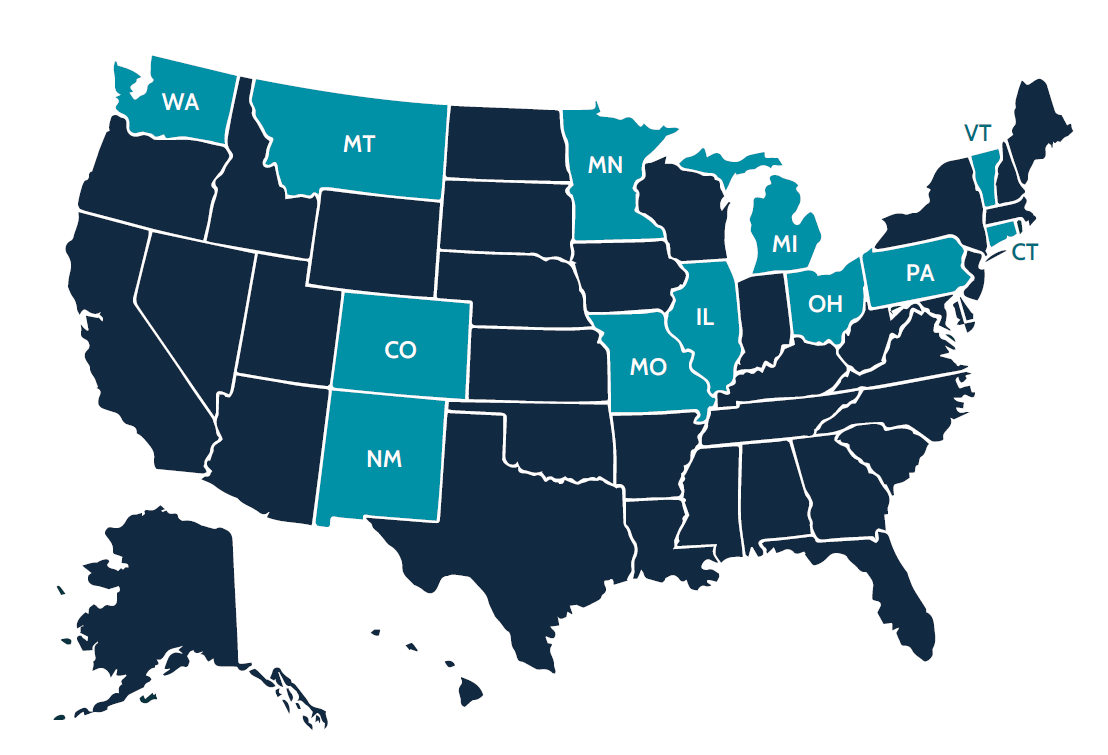
We found that 12 states fall into the “whole child” typology (see Figure 2). Notably, these states have consolidated a comprehensive set of services leveraging various governance structures. Four states (Colorado, Connecticut, Illinois, and New Mexico) established a department of early childhood, and 3 states (Missouri, Montana, and Pennsylvania) established an early childhood division within a larger department.
Notably, Pennsylvania is the only state with a co-administered division for early childhood, and Montana is the only “whole child” state which does not currently offer statewide public pre-K.
Additionally, 5 states (Ohio, Michigan, Minnesota, Vermont, and Washington) established a department of children, youth, and families, which consolidated programming for older as well as younger children. Particularly notable is the inclusion of child welfare services in all but Michigan’s consolidated departments and the inclusion of TANF and SNAP in Minnesota and Vermont’s consolidated departments.
As we conducted case studies and presented our landscape finding at various events, we heard that “whole child” states have experienced a multitude of benefits and challenges due to their structure. During this project, we repeatedly heard that consolidation allowed for greater accountability, more effective advocacy, and often increased funding into a trusted system. Yet, consolidation is not necessarily a silver bullet; strong leadership, widespread support, and a clear vision for change are critical to the success of newly consolidated entities.
Learn more about the “whole child” approach through our case studies of New Mexico and Ohio.
School Readiness
The “school readiness” typology refers to states which house key education programs in one to two departments or divisions; key education programs include child care subsidies, pre-K, Head Start State Collaboration Offices, licensing, and Quality Rating Improvement Systems (QRIS).ii Although some states have fully consolidated their education programs, many more have partially consolidated; as such, pre-K does not have to be housed with child care subsidies to be considered a “school readiness” state.
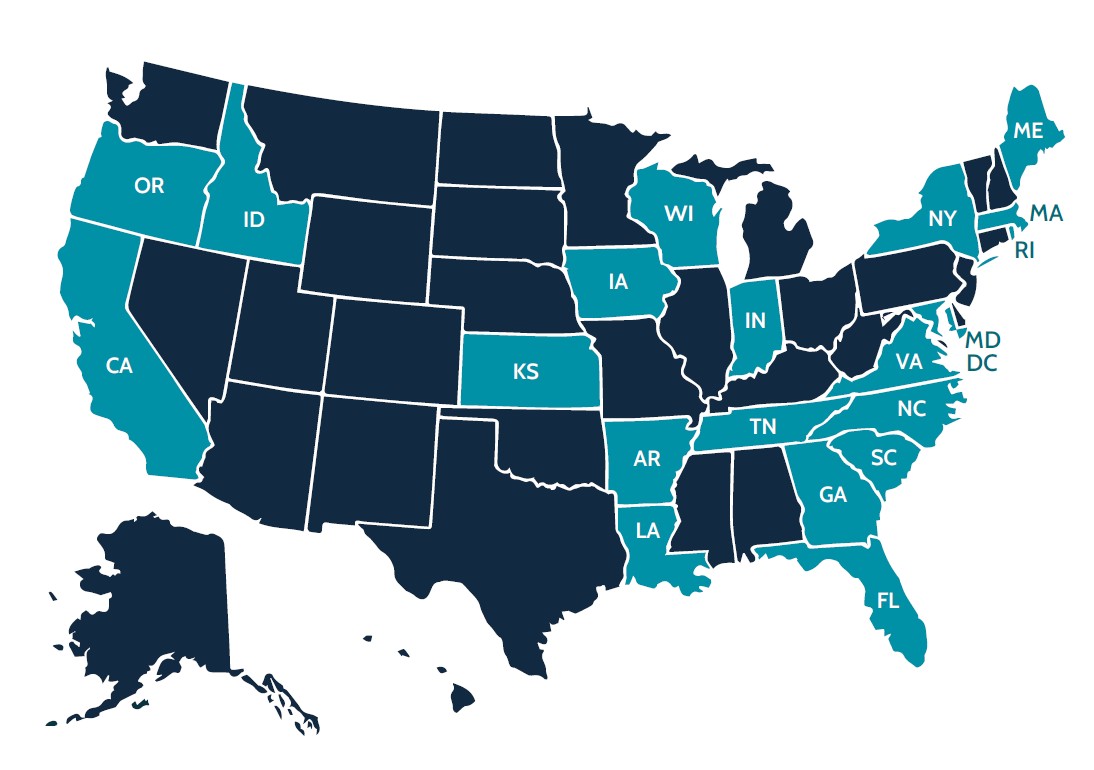
We found that 21 states fall into the “school readiness” typology (see Figure 3). Eight states (District of Columbia, Georgia, Indiana, Louisiana, Maryland, Massachusetts, Oregon, and Virginia) have consolidated all five key education programs into one department or division. Of these states, three states (Georgia, Massachusetts, and Oregon) have established a department of early childhood, whereas the remainder have a dedicated early childhood division within a department, most commonly within a department of education.
Additionally, another 11 states (Arkansas, California, Florida, Idaho, Iowa, Kansas, Maine, North Carolina, Rhode Island, Tennessee, and Wisconsin) have consolidated all their key education programs across two departments.iii Program groupings often result in pre-K and/or the Head Start State Collaboration Office housed in a separate department (commonly a department of education) from child care subsidies, licensing, and QRIS.
Finally, two states (New York and South Carolina) have programs spread across more than two departments but were nonetheless recognized as most closely matching the “school readiness” typology. Specifically, although New York’s key education programs are housed across four departments, all programs are housed in early-childhood focused divisions. South Carolina’s key education programs are housed across three departments, with most programs housed in a department of human services and pre-K co-administered between a department of education and a quasi-governmental entity, First Steps.
ii States are not penalized if they do not offer all 5 key education programs. States that do not have a statewide pre-K program are Idaho, Montana, New Hampshire, South Dakota, and Wyoming. States that do not have a statewide QRIS program are Florida, Hawaii, Mississippi, and West Virginia.
iii Kansas is the only state in this group with has established a department of early childhood, but the pre-K program remains in a department of education.
Again, through our case studies and various events, we repeatedly heard that states with the “school readiness” model experience many of the same benefits as the “whole child” states, albeit restricted to their early education
system. These include greater efficiency and accountability and a clear shared goal with widespread support. Yet, critical health and economic programs remain fragmented, requiring intentional coordination to address families’ holistic needs.
Learn more about “school readiness” approach through our case studies of Kansas, South Carolina, and Virginia.
Parents’ Workforce Participation
The “parents’ workforce participation” typology refers to states which have placed child care subsidies with workforce supports. Specifically, in these states subsidies often remain housed with TANF and SNAP programs
in divisions of economic stability/security/assistance or workforce/ employment. As such, even if states’ key education programs are housed across two to three departments, the housing of education and economic programs together indicate states consider subsidies as another lever to increase workforce participation.
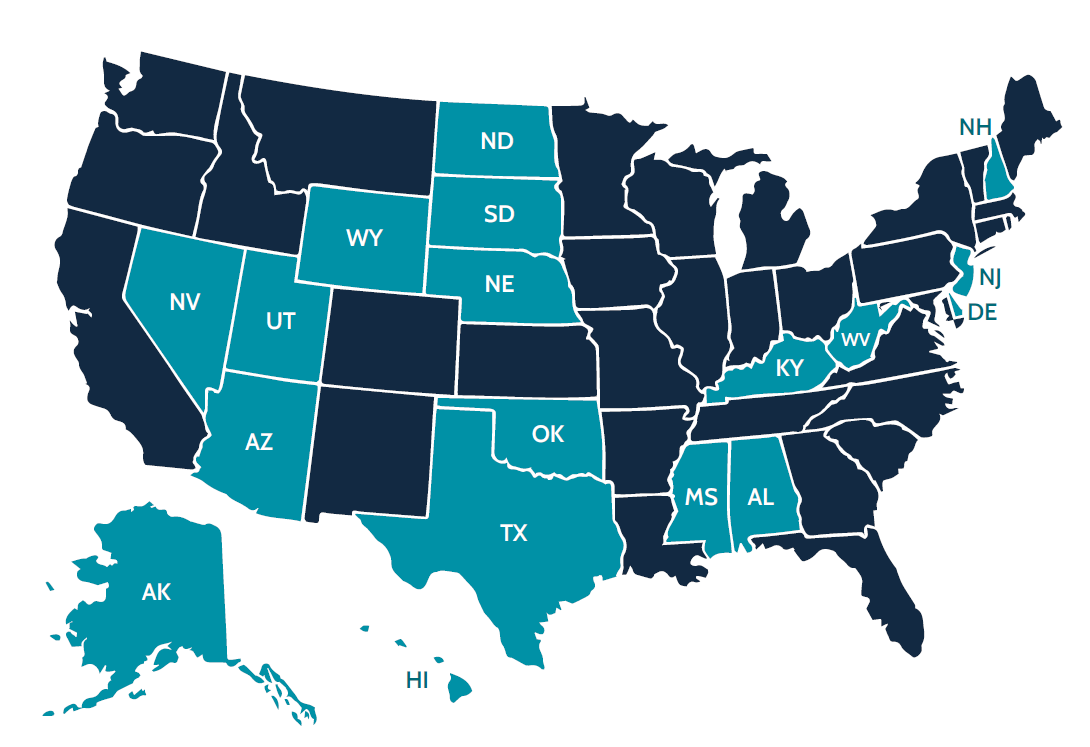
We found that 18 states fall into the “parents’ workforce participation” typology (see Figure 4). These states are Alabama, Alaska, Arizona, Delaware, Hawaii, Kentucky, Mississippi, Nebraska, Nevada, New Hampshire, New Jersey, North Dakota, Oklahoma, South Dakota, Texas, Utah, West Virginia, and Wyoming. Of these states, Alabama is the only state with an early childhood-focused department.
Although we have not conducted case studies on these categories, it seems likely that if coordination is done well within this structure, it could be helpful for parents seeking employment to link workforce supports with education and care programs for their children. In fact, this typology reflects the historic organization of welfare programs before the 1996 reform, in which cash assistance and child care were interwoven in welfare-to-work initiatives.
Further research on the “parents’ workforce participation” typology is needed to fully understand the benefits and challenges of this structure.
Learn more about the historic ties between child care and cash assistance in our History of Child Care Policies.
Conclusion
States approach early childhood governance in a variety of ways, and these choices can impact parents’ awareness of, access to, and experience with early childhood programs and services. Yet research to date provides little guidance on best practices of early childhood governance.
This work begins to address the gap in knowledge about optimal early childhood governance by mapping the unique governance structure of each state and the District of Columbia. In doing a national landscape scan of all education, health, and economic and family supports available, 3 governance typologies emerged through which states’ governance choices can be understood.
Although each state has a unique context, these governance typologies can benefit state leaders pursuing governance change to ensure new structures reflect the early childhood goals of the state.
Authors
Brief Prepared by: Becca Hanlin Lustick, MA; Cynthia Osborne, PhD; and Abby Lane, PhD
Acknowledgements: Thank you to the state leaders that provided data clarifications and to our colleagues at the Center for American Progress and Education Commission of the States for their support and collaboration. Special thanks to our Prenatal-to-3 Policy Impact Center colleagues Jennifer Huffman, MPAff, Alyssa Rafa, MA, Sierra Rowe, MPAff, and Lunaa Hao who were critical in developing the national landscape scan and resulting typologies.
Recommended Citation
Prenatal-to-3 Policy Impact Center (2026). Early Childhood Governance Typologies: Patterns in State Governance Across the Nation. Peabody College of Education and Human Development. Vanderbilt University. https://pn3policy.org/early-childhood-governance.