Introduction to the Davidson County Child Care Landscape Study
Results show that the greater Davidson County child care system faces interconnected challenges related to child care supply, workforce stability, and high-quality child care affordability. Explore the Executive Summary.
High-quality child care is an essential resource for families and young children. Reliable child care enables parental workforce participation, simultaneously providing children with a safe, nurturing, and structured environment that promotes healthy development.1 Quality child care also strengthens families’ economic stability, improving child developmental outcomes and promoting broader economic growth.2
Despite the essential need for child care, families across the United States face challenges accessing and affording it. Additionally, child care programs face challenges maintaining financially sustainable businesses, and early childhood educators are often not paid enough to cover basic household necessities.3 Though these access and workforce challenges are widespread across the country, developing effective solutions requires an understanding of the unique conditions shaping local child care systems.
To inform strategies to improve the local child care system in greater Davidson County, United Way of Greater Nashville engaged the Prenatal-to-3 Policy Impact Center at Vanderbilt University (Policy Impact Center) to conduct the Davidson County Child Care Landscape Study.
This study, using novel data collected from the Davidson County Child Care Provider Experience Survey (Child Care Provider Survey), examines local child care supply, population metrics that inform demand, the local ECE workforce, operating conditions of local child care programs, and the estimated cost of providing high-quality child care in greater Davidson County. Nearly half (47%) of all reachable licensed child care programs (N=275) in greater Davidson County participated in the Child Care Provider Survey during the Summer of 2025. The study includes responses from 116 center-based and 14 home-based programs, for a total of 130 child care programs.
Results show that the greater Davidson County child care system faces interconnected challenges related to child care supply, workforce stability, and high-quality child care affordability. This brief provides an executive summary of the key findings presented across the Davidson County Child Care Landscape Study five-part brief series.
Local Center-Based Child Care Supply
Brief 1, Early Education for the Next Generation, examines the current supply and availability of center-based child care.
Child Care Centers Have 22,184 Slots For Children Ages Birth to 5 Years Old
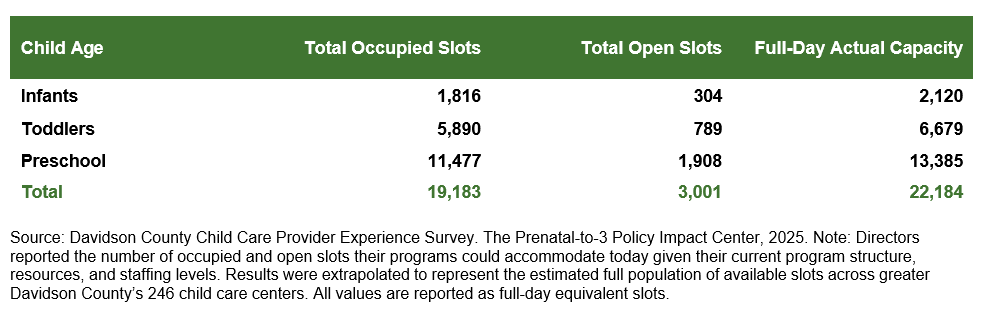
Based on responses of child care program directors from the Child Care Provider Survey, we estimate that across greater Davidson County’s 246 child care centers, 19,183 full-day equivalent child care slots are occupied by children under age 5, and an additional 3,001 are open and available to families today (see Figure 1). Full-day equivalent child care slots are defined as licensed child care slots that can either be allotted to one child using full-time care or allotted to more than one child using part-time care.
Together, these occupied and open slots represent greater Davidson County’s full-day actual capacity, or total child care supply, of 22,184 child care slots. Among slots occupied by children enrolled in full-time care, approximately 15 percent are filled by children whose families use child care certificates to pay for care.
Greater Davidson County has a local population of approximately 39,900 children under age 5 with all parents in the workforce.4 Therefore, current center-based child care supply can accommodate just over half (56%) of local working families with children under age 5.
Infant Care Is Limited; Child Care Centers Can Serve Only 1 in 5 Infants
The Early Care and Education Workforce
Brief 2, The People Behind Early Care and Education, examines the size and composition of the early care and education (ECE) workforce, as well as key child care program characteristics, at center-based child care programs.
Child Care Centers Employ 4,226 Early Childhood Educators With Varying Levels of Education and Experience
An estimated 4,226 early childhood educators work in child care centers across greater Davidson County. Of these local educators, an estimated 60 percent serve in lead teacher roles, and 40 percent serve in assistant teacher or rotating assistant roles.
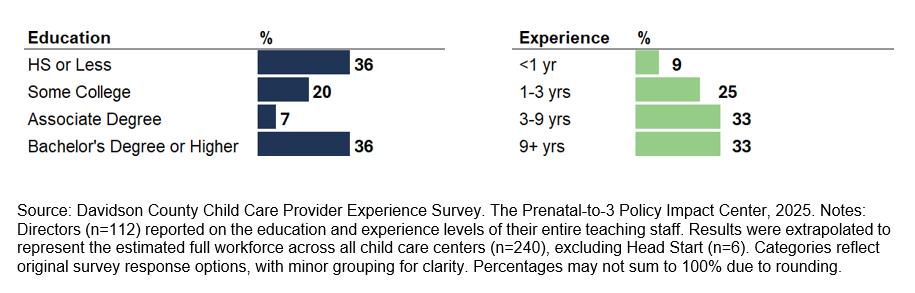
On average, center-based programs in greater Davidson County employ educators across a range of education levels. On average across child care centers, an estimated 36 percent hold a bachelor’s degree or higher, 27 percent have either an associate degree or some college credits, and 36 percent have a high school diploma or less (see Figure 2).
Similarly, center-based programs in greater Davidson County employ educators at various stages of their careers, with approximately one-third (34%) of early childhood educators having 3 years or less of experience and approximately one-third (33%) having 9 or more years of experience.
Child Care Centers Pay Educators an Average Wage of $18.15 Per Hour
91%
At Least 2 in 5 Child Care Centers Do Not Offer Health Insurance or Retirement Plans
More Than Half of Child Care Centers Have High Annual Turnover (>20%)
Just Under Half of Child Care Centers Report Operating at a Profit
Financial conditions vary across center-based programs in greater Davidson County. In the Child Care Provider Survey, 47 percent of centers report operating at a profit. Conversely 31 percent describe themselves as breaking even, and 16 percent report operating at a loss.
Most surveyed child care directors report they will need to make adjustments soon in response to current financial and operating conditions, with 68 percent of programs reporting they are likely to raise tuition rates in the next 6 to 12 months.
Local Home-Based Child Care Supply
Brief 3, Limited Providers, Limited Slots, examines the home-based child care system.
Greater Davidson County Has Exceedingly Few Licensed Home-Based Child Care Programs, and They Are Largely Full
Greater Davidson County is home to 29 licensed home-based child care programs, representing just 1 percent of all licensed child care slots in the region. Of these 29 home-based child care programs, 14 responded to the Child Care Provider Survey, and we report on program operations at these providers.
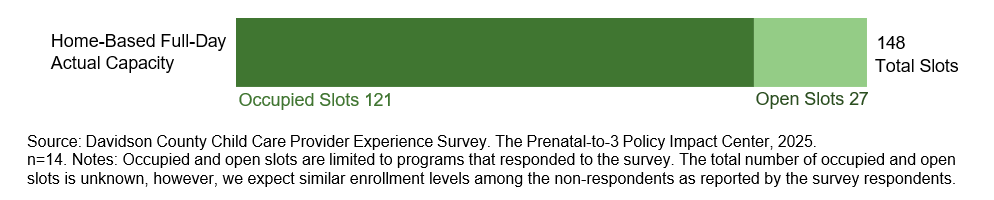
Across the 14 home-based survey respondents, 121 full-day equivalent slots are currently occupied by children under age 5, and just 27 full-day equivalent slots remain open and available to all families seeking licensed home-based child care in greater Davidson County (see Figure 3).c The profound scarcity of licensed home-based child care slots leaves virtually no capacity to accommodate demand from families seeking this type of care.
Importantly, the Davidson County Child Care Landscape Study was limited to licensed child care programs and does not capture the characteristics or experiences of unlicensed home-based child care programs. The overall prevalence of unlicensed home-based child care is unknown.
Examining why greater Davidson County has so few licensed home-based child care programs is outside the scope of this study. However, local barriers may prevent prospective providers from becoming licensed, identifying an area for further research.
Modeling the Local Cost of High-Quality Child Care
Brief 4, What High-Quality Center-Based Care Really Costs, and Why No One is Paying It, and Brief 5, Estimating the True Cost of High-Quality Home-Based Child Care, examine the cost of providing high-quality center-based and home-based child care for children under age 5 in greater Davidson County.
The Monthly True Cost of High-Quality Center-Based Child Care Ranges from $2,214 for Preschoolers to $3,457 for Infants
Tuition prices of a child care program show what the program is charging families for care, but may not reveal what that care actually costs to provide. Child care prices are constrained by what families can afford; child care programs often cannot increase prices to reflect the actual cost of services, including ensuring educators are paid a living wage, without pricing families out of the market.
Cost estimation models generate a comprehensive estimate of the total cost to sustain a high-quality child care program with a stable workforce. Cost estimation models account for all of the expenses involved in delivering high-quality child care, including labor costs (i.e., educator wages) that reflect a living wage and fair benefits, facility expenses, and learning materials, without being constrained by what families are able to pay.14
To estimate the cost of providing high-quality child care in greater Davidson County, the Policy Impact Center created a locally-tailored child care cost estimation model. The cost estimation model reflects the average program size and structure of local centers based on information from the Child Care Provider Survey, accounts for greater Davidson County-specific costs, and reflects the priorities of local child care community partners and experts (Child Care Workgroup).
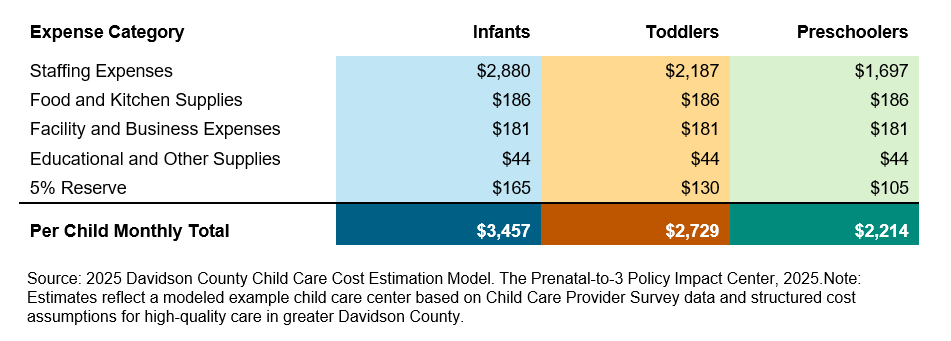
The cost estimation model reveals that the estimated monthly cost of high-quality center-based child care is $3,457 for infants, $2,729 for toddlers, and $2,214 for preschoolers in greater Davidson County (see Figure 4).
Staffing costs, which represent the largest share of the cost of child care (83%), vary by age group because of required ratios and group-size limits, whereas non-staff expenses (food, supplies, etc.) are allocated evenly among all children served in a center. As a result, infant care is the most expensive because lower educator-to-child ratios and smaller group sizes require more educators per child. In other words, fewer families share the staffing costs for an infant class, resulting in higher costs per infant slot. Consequently, the high cost of infant care often leads programs to offer limited infant classes in favor of more profitable preschool classes.
A Median-Income Single Parent with Two Children Would Face Costs Equivalent to 143% of Their Annual Income at the True Cost of High-Quality Care
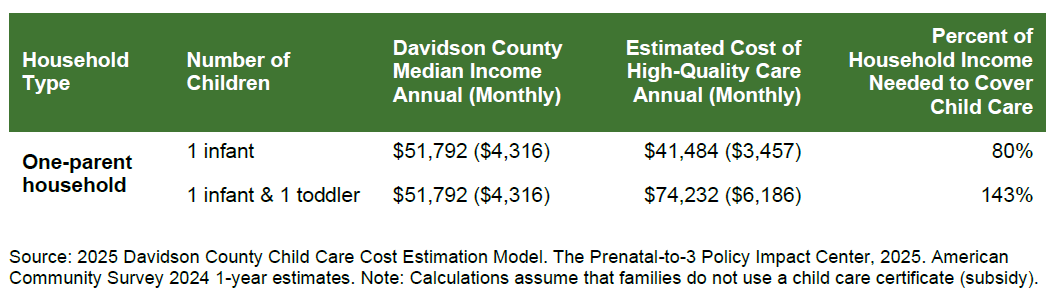
If child care centers charged tuition that reflected the estimated true cost of high-quality care, the resulting prices would be unattainable for most families. In greater Davidson County, high-quality child care for one infant and one toddler, priced at the estimated true cost of care, would represent roughly 143 percent of the median household income for a one-parent household (see Figure 5).
This reality underscores why child care centers often cannot set tuition equal to the estimated cost of high-quality care as a strategy for increasing educator pay to ensure a living wage and benefits without risking pricing most families out of the market.
The Monthly True Cost of High-Quality Home-Based Child Care Ranges from $1,669 to $2,158
Home-based child care programs are typically much smaller than centers and operate out of a private residence. Tennessee child care regulations divide home-based child care into two categories: family home-based programs and group home-based programs.
The estimated true cost of high-quality family home-based care is $2,158 per month per child across all ages. This framework includes capacity and staffing for seven children.
The estimated true cost of high-quality group home-based child care is $1,669 per child across all ages. This estimate includes capacity and staffing for up to 12 children up to school age and three additional school age children.
Conclusion
The Davidson County Child Care Landscape Study provides a detailed look into the local center-based and home-based child care supply, ECE workforce, and estimated costs of providing high-quality child care.
Across greater Davidson County, 246 center-based child care programs offer approximately 22,000 child care slots. This supply, however, provides only enough center-based child care slots for just over half of all children under age 5 in the region with all parents working, and infant care is especially scarce. Licensed home-based child care programs represent an exceedingly small share of the region’s child care supply and do little to fill the gap.
Centers employ more than 4,000 early childhood educators with varying levels of education and experience. On average across centers, the share of educators with only a high school degree or less is equal to the share holding a bachelor’s degree or higher (36%), and two-thirds of educators have 3 or more years of experience in ECE.
Centers report paying an average wage of $18.15 per hour, which is not enough to meet basic needs in the region. Child care directors report that educator turnover is a major challenge, with more than half of centers losing more than 20 percent of educators annually. Directors cite increasing pay would be an effective strategy to reduce turnover, but also report financial constraints, with more than half of centers not profitable and more than two-thirds planning to raise tuition in the next year.
When modeling the true cost of high-quality center-based child care in the region, ensuring educators earn a living wage, the cost ranges from $2,214 for preschoolers to $3,457 for infants per month. Most parents could not afford to pay the true cost of care; it would require 80 percent of income from a single parent making the county median income just to pay for one infant to attend child care while they worked. These challenges face the child care industry nationwide, not just in greater Davidson County, and perpetuate a system of low educator wages and high educator turnover.
Leveraging the strengths and addressing these interconnected challenges throughout the local child care system will require coordinated and informed decision-making. Together, these findings provide a foundation to guide next steps in strengthening greater Davidson County’s child care system for the benefit of children, families, educators, and providers alike.
Davidson County Child Care Landscape Study Resources
About the Davidson County Child Care Landscape Study
The United Way of Greater Nashville is engaging the Prenatal-to-3 Policy Impact Center at Vanderbilt University (Policy Impact Center) to conduct the Davidson County Child Care Landscape Study to examine child care supply, population metrics that inform demand, and the estimated cost of providing high-quality child care in Davidson County. The Davidson County Child Care Landscape Study consists of three phases.
- Phase 1 focuses on using state- and national-level publicly available data to understand the population and demographic characteristics of Davidson County that inform local child care demand and current supply. Though these data provided a foundational overview of the local child care landscape, they also revealed limitations in what could be understood without targeted data collection to provide more detailed, local data. A summary of key findings was released in March 2024.d
- Phase 2 consists of an in-depth child care supply analysis based on an original child care provider survey. The Policy Impact Center developed and fielded the 2025 Davidson County Child Care Provider Experience Survey (Child Care Provider Survey) between June and August 2025 to all licensed child care programs in the greater Davidson County area. A total of 130 (116 center-based and 14 home-based) out of 275 (246 center-based and 29 home-based) reachable child care programs participated in the Child Care Provider Survey (47% response rate) and provided sufficient information to be included in our analyses. We present findings from this phase throughout this five-part brief series. The Child Care Provider Survey asked about:
- Child care enrollment and open slots,
- Staffing, workforce characteristics, and educator wages,
- Child care program director experiences and challenges.
- Phase 3 uses a cost estimation model informed by Tennessee- and Davidson County-specific data and input from local child care experts and community partners to estimate the cost of providing high-quality child care in Davidson County. We discuss findings from this phase pertaining to center-based child care and home-based child care in Briefs 4 and 5, respectively, of this five-part series.
Results from the Nashville Child Care Landscape Study will inform child care expansion planning, resource allocation decisions, and policy and funding advocacy.
A complete description of the methods used in this brief can be found in the online Methods Appendix.
Who We Are
Prenatal-to-3 Policy Impact Center
The Prenatal-to-3 Policy Impact Center translates the science of the developing child into state-level policies that have the strongest evidence of improving outcomes for infants, toddlers and their parents. Based in Vanderbilt University’s Peabody College of Education and Human Development, the Center’s team of researchers and nonpartisan policy experts work with policymakers, practitioners, and advocates to navigate the evidence on solutions for effective child development in the earliest years. Learn more at www.pn3policy.org.
United Way of Greater Nashville
At United Way, we unite the community and mobilize resources so that every child, individual and family thrives. Together, we are working to create a community where every child receives a quality education, no one lives in poverty or poor health, and the most basic needs of our families are met. Serving the community for more than 100 years, United Way of Greater Nashville is also recognized as the founding chapter of the Alexis de Tocqueville Society, a now global giving society that has invested more than $10 billion in the work of United Ways worldwide. United Way of Greater Nashville is creating lasting change throughout Middle Tennessee. We are uniquely positioned to do this work by bringing individuals, businesses, nonprofits and government to the table to have the tough conversations, mobilize the resources and make the smart investments that will create lasting solutions for our region’s most pressing issues. Our service area includes Cheatham, Davidson, Dickson, Hickman, Houston, Montgomery, Robertson, Stewart and Williamson counties. Learn more at www.unitedwaygreaternashville.org.
Raising Readers Nashville
Raising Readers Nashville is a collaborative working to support systems change in the area of early childhood education. We serve the early childhood community by working to improve literacy in four domains of focus: Ready to Read, Literacy Skill Development, Family and Caregiver Engagement and Educator Support. We do this in four ways, incubator, a leader of active initiatives, convenor or accelerator where we partner with community and as champion to amplify the work of others. Learn more at www.raisingreadersnashville.org
References
1 First Five Years Fund. (2024, March 6). Fact sheet: Child care and the economy. https://www.ffyf.org/2024/03/06/fact-sheet-child-care-and-the-economy/
2 Osborne, C., Kresse, A., Skatter, N., Xu, N., Huffman, J., & Craig, S. (2024, July 15). Early investment, a lifetime of returns: Articulating the value of early childhood investments in Virginia. Prenatal-to-3 Policy Impact Center. https://pn3policy.org/early-investment-a-lifetime-of-returns-articulating-the-value-of-early-childhood-investments-in-virginia/
3 Administration for Children and Families (ACF). (2024, October 24). Understanding families’ needs and preferences to Advance Measurement of Equitable Access to Child Care and Early Education. U.S. Department of Health and Human Services. https://acf.gov/sites/default/files/documents/opre/opre-understanding-families-needs-preferences-oct24.pdf
4 US Census Bureau. (2023). Age of own children under 18 years in families and subfamilies by living arrangements by employment status of parent: 2023 ACS 5-year Estimates Detailed Table (B23008) [Data Set]. https://data.census.gov/
5 Centers for Disease Control and Prevention, National Center for Health Statistics. (2024). National Vital Statistics System: Natality (2016–2024). [Data set]. CDC WONDER Online Database. http://wonder.cdc.gov/natality-expanded-current.html
6 United For ALICE. (2023). ALICE county reports: Tennessee. United Way of Northern New Jersey. https://www.unitedforalice.org/county-reports/tennessee
7 Center for the Study of Child Care Employment. (2024). Early childhood workforce index 2024: Key findings. University of California, Berkeley. https://cscce.berkeley.edu/workforce-index-2024/executive-summary/key-findings/
8 Vicente, D., Venegas, M., & Guerrero, A. D. (2025). Turn-over and retention among Head Start educators. Early childhood education journal, 53(5), 1467-1478.
9 Holochwost, S. J., DeMott, K., Buell, M., Yannetta, K., & Amsden, D. (2009, October). Retention of staff in the early childhood education workforce. In Child & Youth Care Forum (Vol. 38, No. 5, pp. 227-237). Boston: Springer US.
10 Amadon, S., Lin, Y.-C., & Padilla, C. (2023). Turnover in the center-based child care and early education workforce: Findings from the 2019 national survey of early care and education. OPRE Report #2023-061 Office of Planning, Research, and Evaluation, Administration for Children and Families, US Department of Health and Human Services. https://acf.gov/sites/default/files/documents/opre/workforce_turnover_snapshot_apr2023.pdf
11 Whitebook, M., McLean, C., & Austin, L. J. E. (2016). Early childhood workforce index – 2016. Center for the Study of Child Care Employment, University of California, Berkeley. https://cscce.berkeley.edu/files/2016/Index-2016.pdf
12 Bryant, D., et al., (2023). Retention and turnover of teaching staff in a high-quality early childhood network. Early Childhood Research Quarterly, 65, 159-169. https://doi.org/10.1016/j.ecresq.2023.06.002
13 Vicente, D., Venegas, M. & Guerrero, A.D. (2025). Turn-over and retention among Head Start educators. Early Childhood Educ J. 53, 1467–1478. https://doi.org/10.1007/s10643-024-01685-x
14 Workman, S. (2021, June 28). The true cost of high-quality child care across the United States. Center for American Progress. https://www.americanprogress.org/article/true-cost-high-quality-child-care-across-united-states/
Authors
Report Prepared by:
Cynthia Osborne, PhD; Sierra Rowe, MPAff
Acknowledgements:
Monica G. Navarro; Sean Craig, MA JD; Kels Bowman, PhD; Jennifer Huffman, MPAff; Kaeley Benson, PhD; and Sarah Brown
Recommended Citation:
Prenatal-to-3 Policy Impact Center (2026). Davidson County Child Care Landscape Study Executive Summary. https://pn3policy.org.