
Recent survey data from North Texas indicate that early childhood educator wages remain far below the local living wage, regardless of years of experience or education level, offering little incentive for educators to stay or advance in the field.
Yet the child care system continues to rely on early childhood educators who are consistently underpaid, despite being tasked with one of the most critical jobs in society. Nationally, early childhood educators earn less than 98 percent of other occupations, placing them among the lowest-paid workers in the country.3

Inadequate compensation fuels instability, with 13 to 25 percent of educators leaving their positions within a single year.4 The consequences ripple outward: turnover disrupts children’s care and contributes to care shortages, especially in infant and toddler care, which costs the US an estimated $122 billion annually in lost earnings, productivity, and revenue.5
Many strategies to improve child care focus on professionalizing the workforce and reducing turnover. This brief spotlights new data on low wages and lack of wage growth for educators, which can inform child care capacity solutions.
Only 4 percent of early childhood educators in North Texas earn a living wage
The median hourly wage for early childhood educators in North Texas is $15 per hour, which translates to an annual wage of $31,200 for a full-time educator.c
$15
$23.86
71
c Assuming year-round employment with no unpaid time off
d Linear projection based on observed change from $13.33 to $16.28 over 20 years (≈$0.1475/hr per year). Real wages vary by program, role, and tenure; this illustrates the order of magnitude of the gap.
Educators with 20 years of experience earn only $2.95 more per hour than those starting out, and wages show only modest gains from additional education
Delivering high-quality child care requires early childhood educators to have the knowledge and skills to provide safe, nurturing, and responsive care.
Yet, despite these high professional expectations, early childhood educators are not compensated for their skills, experience, and preparation.
Educator wages fall into a very narrow range, whether they are new to the field or have been teaching for decades. The average center-based early childhood educator with a high school diploma earns $13.33 per hour in their first year on the job, and shockingly, only $16.28 after more than two decades of experience – an increase of just $2.95 per hour, or approximately $6,136 annually after a 20-year career.
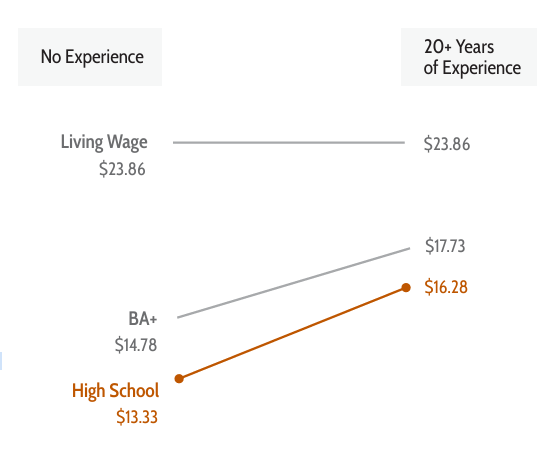
Wage estimates by education and experience are based on observed averages from survey data. Because these data are descriptive, they do not model potential interaction effects between education level and years of experience. As a result, the trajectories shown assume a similar rate of wage growth across education levels.
Gains from each additional year in the field are modest, and even after two decades of experience, predicted wages remain well below the regional living wage threshold.
The median hourly wage for early childhood educators in North Texas is $15 per hour, which translates to an annual wage of $31,200 for a fulltime educator.
Considering the time and resource costs of obtaining higher education, observed wage gains with more education are quite small.
To illustrate how educator wages differ by education and experience, we modeled predicted hourly wages for center-based educators at the start of their careers and after 20 years.
Who Makes Up the Workforce?
Most center-based early childhood educators in North Texas have limited formal education beyond a high school diploma, though approximately a quarter hold a bachelor’s degree or higher.
51%
10%
Even early childhood educators who pursue additional education see only modest gains. Educators who enter the field with a bachelor’s degree have a small initial advantage, $1.45 more per hour or approximately $3,016 more per year, compared to educators starting with only a high school diploma.
This leg up puts a bachelor’s-holding educator at the start of their career roughly at the same pay level as a high school-educated colleague with 11 to 20 years of experience. Still, most educators enter the workforce without even this modest advantage (see sidebar above, Who Makes Up the Workforce?).
Long-term pay for an educator with a bachelor’s degree remains far below a living wage. After more than 20 years in the field, an early childhood educator earns an average of approximately $17.73 per hour ($36,878 annually), or $12,751 below a living wage.
By comparison, jobs in retail, food service, or custodial work often offer equal or higher pay with far fewer professional demands, such as state-mandated annual training or being accountable for children’s development.7 In 2023, fast food workers in Texas received an average wage of $14.48 an hour, or approximately $2,300 more annually than a new early childhood educator in North Texas.8
Conclusion
The math underscores a stark reality: not only are typical early childhood educator wages low, but obtaining education or staying in the field to obtain more experience does not lead to a meaningful wage increase.
Across North Texas, early childhood educator wages remain far below a living wage, with only modest gains even for those who commit their careers to the field. Without meaningful improvement in compensation, instability in the early childhood workforce will likely persist, undermining both children’s development and families’ access to care.
The Low Wages brief
Other Resources
The full North Texas Study report
Other briefs from the North Texas Study
About the Data
Findings from this brief are based on the 2024 North Texas Child Care Director Survey, conducted by the Prenatal-to-3 Policy Impact Center in partnership with Child Care Associates between November 2024 and January 2025. Workforce demographic data were estimated from 2,772 educators across 395 child care programs, with data collected from child care program directors. Wage analyses were derived from a subsample of 2,238 centerbased educators across 216 child care centers. Responses from child care providers were analyzed alongside state licensing data and data from the US Census Bureau’s American Community Survey (ACS) to calculate estimates for the region’s population of 3,108 child care programs. For the full report, see https://pn3policy.org/the-northtexas-child-care-workforce-study
Citations
1 https://harvardcenter.wpenginepowered.com/wp-content/uploads/2012/05/The-Science-of-Neglect-The-Persistent-Absence-of-Responsive-Care-Disrupts-the-Developing-Brain.pdf
2 https://pn3policy.org/policy-goals/nurturing-and-responsive-child-care-in-safe-setting/#why-is-nurturing-and-responsive-child-care-in-safe-settings-an-important-prenatal-to-3-goal
3 https://cscce.berkeley.edu/workforce-index-2020/the-early-educator-workforce/early-educator-pay-economic-insecurity-across-the-states/
4 Bassok, D., Markowitz, A. J., Bellows, L., & Sadowski, K. (2021). New evidence on teacher turnover in early childhood. Educational Evaluation and Policy Analysis, 43(1), 172-180.
5 https://www.strongnation.org/articles/2038-122-billion-the-growing-annual-cost-of-the-infant-toddler-child-care-crisis
6 Glasmeier, A. (2025). Living wage calculator. Massachusetts Institute of Technology, Accessed on April 1, 2025, https://livingwage.mit.edu/metros/19100
7 https://texasrisingstar.org/wp content/uploads/2024/04/TRS_Cat_1_Training_Plans_and_Staff_Quals_2024.pdf
8 https://www.bls.gov/oes/2023/may/oes353023.htm