HOW DID STATES CHANGE THE EARLY CHILDHOOD POLICY LANDSCAPE IN 2026?
Big policy wins for families with young children happened across the country this past legislative session. Since our last Roadmap was released in September 2025, states enacted, implemented, and increased access to numerous effective policies and strategies. As a result, states:
For details on these policy wins and more, read through the information in the accordions below or each policy and strategy profile.
States Increased Families’ Earnings by Increasing the State Minimum Wage
23 states increased the minimum wage this year, with increases ranging from $0.28 per hour in Minnesota to $2.00 per hour in Hawaii. For the thousands of workers earning the state minimum wage, even a $0.25 per hour increase adds up. This small increase totals $520 annually for a full-time worker, covering the cost of about 4 weeks of groceries.
Seven states hit a major milestone this year, newly crossing the $15.00 per hour threshold. This brings the total number of states with minimum wages at or above $15.00 per hour to 19, in stark contrast to 20 states with minimum wages of $7.25 per hour.
3 States Newly Implemented Paid Family and Medical Leave, Protecting Earnings
The expansion of statewide paid family and medical leave (PFML) programs to Delaware, Maine, and Minnesota this past year is one of the biggest policy wins of 2026. Approximately 84,300 babies are born each year in these states—meaning that tens of thousands of workers who may have previously lacked access to PFML benefits now have time away from work to recover from childbirth and bond with a new child, all while having their earnings protected.
This policy win brings the total of states currently implementing PFML programs to 13. In 2028, that count will further grow to 15 when Maryland and Virginia implement statewide programs.
Additionally, California and New Jersey made important changes to existing policies this year. California expanded the definition of family for family caregiving leave and New Jersey enhanced job protections.
Learn more about progress on economic support policies in the state minimum wage and paid family and medical leave profiles.
States Expanded Child Care Access and Affordability to Keep Parents in the Workforce
Access to safe, stable, and quality child care is necessary to enable parents to work. To facilitate access to care, states made changes in policies related to income eligibility, or the maximum income a family may earn and still qualify for a subsidy to reduce out-of-pocket child care costs.
The biggest win in 2026 was the steps New Mexico took to make child care universal in the state, by removing income eligibility requirements altogether. Additionally, Massachusetts increased its initial income eligibility threshold substantially—up to the federal maximum of 85% of state median income (SMI). Both Florida and Georgia implemented meaningful changes to initial income eligibility requirements but remain below our key policy lever of 85% SMI.
Although child care subsidies can substantially reduce families’ out-of-pocket child care expenses, families may still be subject to copayments. In some cases, families may have no copayments at all, but in others, families may still pay a substantial portion of their income to child care each month. In the last year, six states reduced family copayments by at least 1 percentage point and both Florida and Montana began limiting copayments to 7% of family income or less, the federal government’s standard for affordability.
Furthermore, states supported providers and families’ access to care by raising reimbursement rates. North Carolina enacted a statewide subsidy rate floor which raised provider reimbursement rates in rural areas and 16 states increased reimbursement rates for infants in center-based care. Additionally, Indiana began setting rates based on a cost estimation model, which may better reflect the cost of care, rather than the price providers are able to charge.
Beyond child care subsidies, states also invested in the broader child care system by creating or expanding funding sources, enacting a cost-share model, enacting am employer-provided child care credit, and barriers to entry for home-based child care providers.
Learn more about progress on child care subsidies in the strategy profile.
States Supplemented Earnings Through New and More Generous Family Tax Credits
Another important policy win of 2026 happened in Pennsylvania. In November 2025, Pennsylvania enacted a refundable earned income tax credit (EITC) worth 10% of the federal credit. The credit went into effect immediately, allowing families with two children to receive up to $731 in tax year 2026. Now, 24 states have a state EITC that is as generous or more than Pennsylvania’s credit.
In addition to the new credit in Pennsylvania, three states expanded their credits or made more families eligible. Montana and Vermont implemented increases due to previously enacted legislation—to 20% of the federal credit for all eligible filers in Montana and 100% for childless adults in Vermont. Legislation enacted this past session in Oregon increased the value of the credit for families with children under age 3 from 12% to 17% of the federal credit. Washington also enacted legislation to expand age and income eligibility for the Working Families Tax Credit beginning in tax year 2029.
States can also supplement earnings and reduce the cost of raising children by implementing tax policies like a child tax credit (CTC). This year, Colorado and Rhode Island both enacted new CTCs, which will be available in tax year 2027. Arizona and New Jersey both expanded their existing CTCs, though only New Jersey’s credit is refundable. Georgia’s nonrefundable CTC became available to families in tax year 2026, bringing the total count of states with any CTC to 16.
Learn more about progress on state EITCS and CTC in the policy profile.
Virginia Made Big Policy Changes to Increase, Protect, and Supplement Families’ Earnings
Although several states made important policy changes this past legislative session, Virginia stands out as the state that made the biggest investments in families’ economic security. Legislators passed a minimum wage increase to gradually raise the state minimum wage until it reaches $15.00 per hour in January 2028. Additionally, legislators enacted a 12-week statewide paid family and medical leave (PFML) program; benefits will become available in December 2028. Legislators also extended full refundability of the state earned income tax credit (EITC) through 2030, meaning more families will have full access to the value of the 20% credit.
States Invested in Perinatal Health for Parents’ and Babies’ Wellbeing
The impact of the policies discussed above on economic security is straightforward. Somewhat surprisingly, most of these policies also improve the health and wellbeing of mothers and their babies in the child’s first year of life. Supporting parents and babies during the prenatal period through the child’s first year promotes better parent and child outcomes in the short and long term. To this end states implemented several strategies to promote greater access to perinatal supports.
For example, four states (Arkansas, Louisiana, New Hampshire, and Utah) implemented Medicaid coverage for doula services, which provide important perinatal supports. In these states alone, 57,900 births were financed by Medicaid. Though there are not enough doulas to serve all these births, there is a significant portion of the population that now has access to this benefit. An additional two states (Nebraska and Tennessee) took steps to implement Medicaid coverage for doula services in subsequent years, and Massachusetts and Wisconsin invested in the doula workforce.
In addition, Kansas, Utah, and Virginia all newly invested funding to pilot or scale up group prenatal care services, bolstering access to an effective, alternative form of prenatal care.
Finally, 10 states expanded access to effective screening and connection programs like Family Connects and HealthySteps. Legislators in Illinois laid the groundwork for a statewide universal newborn support system and five states (Alabama, Connecticut, the District of Columbia, New Hampshire, and Ohio) newly invested state funding to expand access to screening programs. Additionally, Alabama, Nebraska, New Hampshire, Oklahoma, and Pennsylvania newly began leveraging Medicaid funding to support screening programs.
Learn more about progress in these policy areas by exploring the community-based doulas, group prenatal care, and comprehensive screening and connection program profiles.
In the Face of Big Wins, Some State and Federal Policy Action May Limit Access to Effective Policies
Importantly, not all policy changes in the last year increased access to effective prenatal-to-3 policies. The federal government implemented changes to Medicaid and SNAP that have limited access to health insurance and nutrition programs. The federal government also rolled back or proposed sweeping changes to early care and education programs, which may lead to families experiencing increased challenges in accessing quality care. Furthermore, many states also took steps to restrict access to effective policies and programs by implementing policy changes that put work requirements into place sooner than required, increased the administrative burden families face in accessing programs, and more.
In the sections that follow, we summarize these and other changes by policy and strategy. Additional details, including the impact of effective policy solutions, detailed legislative and administrative policy activity in the last year, state variation, and the potential impact of federal policy changes can be found in the policy, strategy, and state Roadmap summaries throughout the Roadmap.
HOW CAN STATES USE THE STATE POLICY ROADMAP TO BUILD AN EFFECTIVE PRENATAL-TO-3 SYSTEM OF CARE?
The prenatal to age 3 period is the most rapid and sensitive period of development, and it sets the foundation for long-term health and wellbeing. The science of the developing child points to eight PN-3 policy goals that all states should strive to achieve to ensure families are strong and infants and toddlers get off to a healthy start and thrive.
View state-level outcomes pages to identify priority outcomes within policy goals in your state and explore the wide variation across states on 19 outcome measures of child and family wellbeing.
Rigorous Research Identifies Effective Solutions to Strengthen the Prenatal-to-3 System of Care
Comprehensive reviews of the most rigorous evidence available identified numerous state-level policies and strategies that positively impact at least one of the eight PN-3 policy goals. The effective solutions are profiled throughout this Prenatal-to-3 State Policy Roadmap. When combined, the policies and strategies create a system of care that provides broad-based economic and family supports, as well as targeted interventions to address identified needs.
The research landscape for state-level early childhood policies continues to evolve as states implement new strategies and as researchers study policy change. As the Prenatal-to-3 (PN-3) Policy Impact Center conducts new comprehensive reviews of the most rigorous evidence available and updates past reviews, we continue to identify evidence of effective state policies to improve outcomes in the earliest years and update the Roadmap accordingly.
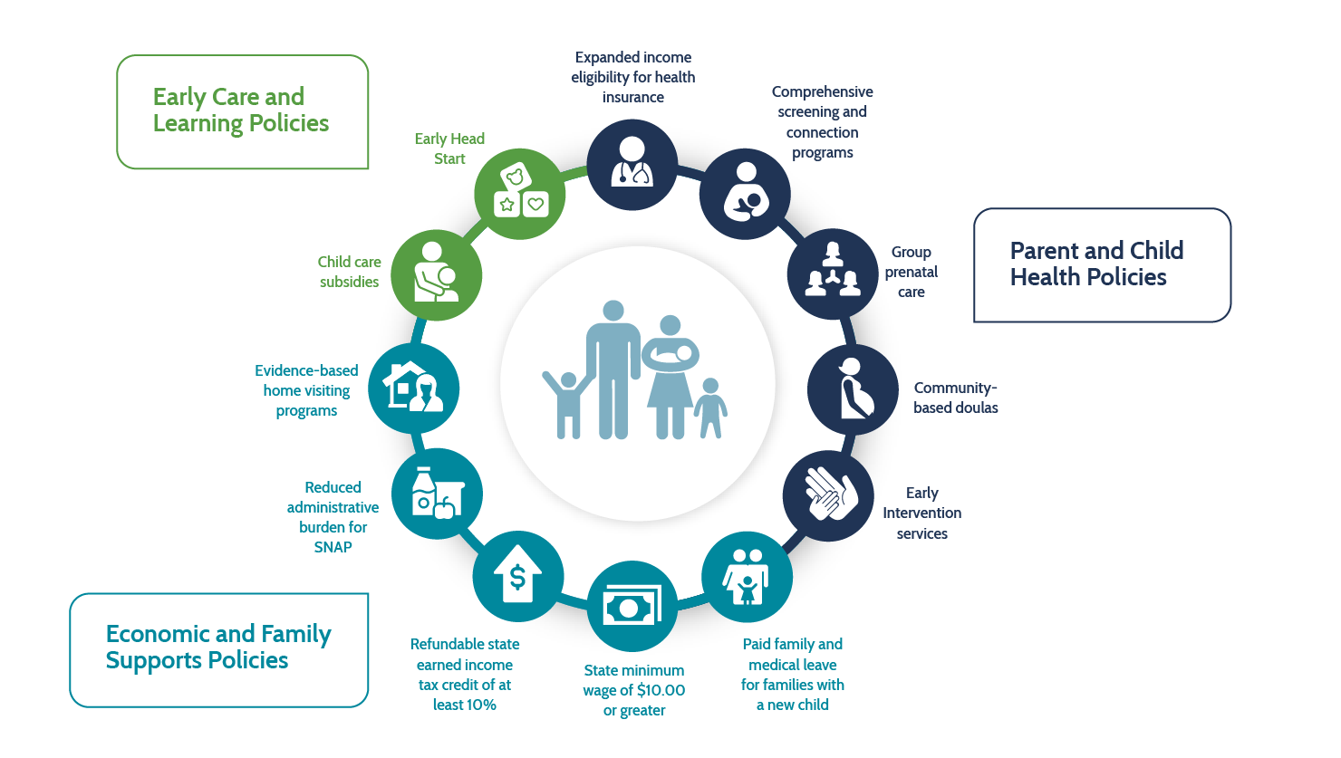
We define policies as an approach for which the rigorous research demonstrates causal impacts on PN-3 policy goals and supports clear state legislative or regulatory action. We define strategies as an approach for which the rigorous research demonstrates causal impacts on PN-3 policy goals but does not yet provide precise guidance for state legislative or regulatory action. We define emerging strategies similarly to strategies, but we are in the process of identifying state policy levers and available data to track state progress in increasing access to these policies.
A profile of each policy and strategy provides extensive information on:
- The impact each solution has on the eight PN-3 policy goals,
- The choices states can make to effectively implement the solutions,
- The progress states have made in the past year toward implementation, and
- How states compare to one another in their generosity and reach of the policies and strategies.
A profile of emerging strategies summarizes the rigorous evidence behind each strategy.
Align Policy Goals to Policy Solutions Proven to Impact Outcomes
Each of the effective solutions in the Roadmap is proven to impact at least one of the eight PN-3 policy goals. The framework below illustrates the alignment between the goals and the evidence-based policies and strategies that impact each goal. For each goal we provide examples of outcomes that illustrate the wellbeing of children and families within that goal, although a policy or strategy may be aligned with other distinct outcomes within the goal. To improve outcomes within a policy goal area, state leaders can prioritize the effective solutions aligned with the goal that demonstrate beneficial impacts.
Similar to the policies and strategies, the emerging strategies on the Roadmap are also aligned with the PN-3 policy goals.
WHAT PROGRESS HAVE STATES MADE IN THE LAST YEAR TO ADOPT AND IMPLEMENT EFFECTIVE POLICIES?
States Made Considerable Progress on Each Roadmap Policy
As highlighted above, four states newly implemented an effective Roadmap policy since the launch of the 2025 Roadmap. Delaware, Maine, and Minnesota newly implemented statewide paid family and medical leave programs and Pennsylvania implemented a refundable earned income tax credit (EITC) of 10% of the federal credit.
In addition to those states newly implementing one or more effective Roadmap policies, many states also invested in increasing access to effective policies by expanding eligibility or making policies more generous. Additionally, several states took important action to consider effective policies, even if legislation to enact policies was ultimately unsuccessful. We provide a summary of state actions in the last year on each effective policy below; see each profile for detailed information by policy.
11 States Have Fully Implemented All 4 Effective Policies
With the implementation of PFML in Maine, 11 states have now adopted and fully implemented all four effective Roadmap policies. Additionally, due to policy changes in the last year, Delaware and Minnesota now implement three of four effective policies, and Pennsylvania now implements two.
“Fully implemented” means that families in the state can currently access the level of benefits that rigorous research finds is necessary to impact PN-3 outcomes. When Maryland and Virginia fully implement their PFML programs in 2028 and families receive benefits, these states will join the group of states that has fully implemented all four effective Roadmap policies.
To date, eight states have not fully implemented any of the effective policies, indicating that there is much work to be done to support children and families in the US.
Importantly, even among states that have implemented a given policy, the generosity and reach of the policy varies considerably across states. We discuss this variation in detail in each of the policy and strategy profiles.
To learn more about state context and legislative activity for each state within a policy area, view the compiled state progress narratives available here.
WHAT PROGRESS HAVE STATES MADE IN THE LAST YEAR TO EXPAND ACCESS TO EFFECTIVE STRATEGIES?
In addition to the effective Roadmap policies, states also invested in the evidence-based strategies this past year through legislative or administrative action. Although the current evidence base does not identify a specific policy lever that states should adopt and fully implement to increase access to the eight effective strategies, the Policy Impact Center has identified a set of key policy levers that may increase families’ access to them.
State Investments in Effective Strategies Were Focused Largely on Community-Based Doulas
The number of states implementing each key lever is identified in the US Roadmap summary graphic at the top of this page. In the last year, states have made the most significant investments in increasing access to community-based doulas. Modest policy changes were made in other areas.
Federal Policy Changes May Impact a Host of Effective Policy Solutions
Additionally, federal policy changes enacted in the One Big Beautiful Bill Act (OBBBA) in July 2025 and through administrative actions from the executive branch may impact the implementation of the effective strategies included in the Roadmap. Policy changes in the federal OBBBA law regarding SNAP and Medicaid funding, may place strain on state budgets and will impact these two programs directly. Additionally, OBBBA-related policy changes may also impact strategies funded by or covered under Medicaid (e.g., comprehensive screening and connection programs, group prenatal care, community-based doulas, evidence-based home visiting, and Early Intervention), and programs housed within the Department of Education (e.g., Early Intervention).
Administrative changes have impacted programs that support parents’ ability to work and children’s access to quality care and education. As of July 2026, the federal government published a final Child Care and Development Fund rule that removed requirements to limit copayments to 7% of family income, develop grants and contracts for certain populations, reimburse providers prospectively, and reimburse based on enrollment. Although states can still implement these policies, they are no longer required to.
Furthermore, in August 2026, the Department of Health and Human services published a Note of Proposed Rulemaking, which may significantly impact the implementation of and families’ access to Early Head Start. The proposed rule change would substantially change Head Start Program and Performance Standards, which serve as the basis for the effective Early Head Start program design supported by rigorous research.
To learn more about state context and legislative activity for each state within a strategy area, view the compiled state progress narratives available here.
HOW DO POLICY CHOICES IMPACT FAMILY RESOURCES ACROSS STATES?
A state’s policy choices do not operate in isolation from one another. Instead, they interact to create a system of support of varying generosity for parents and children. Minimum wages, paid leave, child care subsidies, nutrition benefits, and taxes and credits are significant drivers of the variation across states in the amount of resources a full-time working parent has available to support their family.
The Policy Impact Calculator simulates the minimum level of annual resources available to a model family. The calculator includes earnings from the state minimum wage and paid family leave benefits, out-of-pocket child care expenses after receiving a subsidy, nutrition benefits, and federal and state income taxes and credits.
In the simulation, the mother works full time, year round and earns the state minimum wage. She receives the benefits she is eligible for and files her taxes. The mother takes 12 weeks of leave following the birth of her infant and sends her children to center-based care that charges the 75th percentile of the market rate.
The Policy Impact Calculator demonstrates wide variation in available resources due to state policy choices. The working parent has nearly $51,500 in annual resources to provide for her family in the District of Columbia, and the majority of these resources are earnings from her minimum wage job. Importantly, the parent in the District of Columbia is also eligible for Medicaid, has access to paid family and medical leave, receives a generous state EITC, and may have access to evidence-based comprehensive screening and connection and community-based doulas programs due to the state’s action on key state policy levers. Similar to the District of Columbia, many states at the top of the Policy Impact Calculator rankings provide high minimum wages, statewide paid family and medical leave, generous family tax credits, and also have low out-of-pocket child care expenses.
By contrast, because of low minimum wages, no paid family leave, and high out-of-pocket child care expenses, this same working parent would have just over $19,000 in annual resources for her family if she lives in North Carolina, and most of the resources are benefits that the federal government provides. Many of the states at the bottom of the rankings have similar policies (or an absence of policies) in place. However, because North Carolina has expanded Medicaid under the ACA, the parent is eligible for Medicaid coverage.
Learn More About the Impact of State Policy Choices with the Policy Impact Calculator
The Policy Impact Calculator allows users to:
- Explore how your state ranks on the Policy Impact Calculator using annual data, starting in 2020.
- Explore how federal and state policy choices interact to reach Lina’s total resources. See which policies have the biggest impact on family resources.
- How do state policy changes impact Lina’s family resources? See comparisons over time and across states and simulate policy changes to see their potential impact.
NOTES AND SOURCES
Full source citations can be found throughout the Roadmap policy and strategy profiles as well as Methods and Sources.
- Pub. L. 119-21
Click here to download a summary of the United States 2026 Roadmap (PDF, Coming Soon).
