Lorem ipsum dolor sit amet, consectetuer adipiscing elit, sed diam nonummy nibh euismod tincidunt. Learn More

The Impact of Expanded Income Eligibility for Child Care Subsidies: Analysis of Proposed State Legislation in 2024

PRINT

State leaders can significantly increase the number of children eligible for child care subsidies across the country by expanding income eligibility thresholds.

The level of income at which a family becomes initially eligible for child care subsidies—the income eligibility threshold—is one of the key policy choices state leaders make to impact access to child care subsidies. So far in 2024, at least 10 states have introduced legislation to increase their initial income eligibility threshold to make families with higher income levels eligible for subsidies. This analysis illustrates the impact legislation like this could have on the number of children eligible across states. Dig into the details of these bills and their impact in our Legislative Snapshot. 
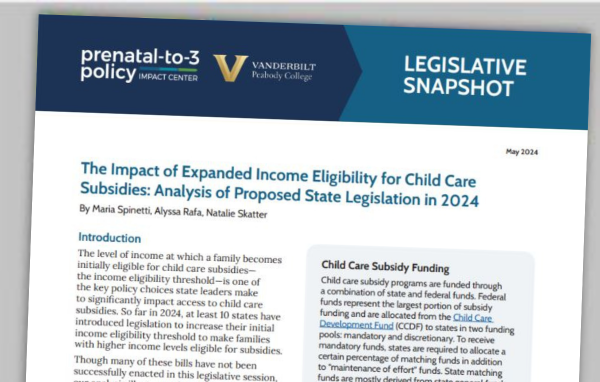
Explore the effects of expanding the income eligibility criteria for childcare subsidies.

Related

A small child sits on a soft mat, focused on stacking colorful rings and holding a toy, while a caregiver engages nearby in a warm home setting

Renewed Support from the Buffett Early Childhood Fund Fuels Continued Growth and Impact at the Prenatal-to-3 Policy Impact Center

Funding will support policy research and evidence translation to inform state action and improve outcomes for young children and families As families navigate evolving social and economic challenges, advancing evidence-based policy solutions is critical. The
Washington State Capitol Legislative Building

The Prenatal-to-3 Policy Landscape in 2026

This blog post outlines the state policy changes in effect since the release of our 2025 Roadmap, providing timely and up-to-date context for consideration as policy discussions continue in 2026.
Photograph of a young girl smiling

New Reports Illustrate Historical Patterns of Inequity in Policy Design and Their Impact Across Generations

Tracing policy decisions from early America to today, the reports reveal how long-standing choices continue to shape access and outcomes for families The Prenatal-to-3 Policy Impact Center at Vanderbilt University published the first installment in