Lorem ipsum dolor sit amet, consectetuer adipiscing elit, sed diam nonummy nibh euismod tincidunt. Learn More

State Policy Lever Checklist: State Child Tax Credit

PRINT

Research is clear that money matters for children’s wellbeing and achievement. Greater income allows parents to better meet children’s basic needs, and financial stability can reduce parental stress. State child tax credits (CTCs) provide one avenue for states to increase family resources. 

This Policy Lever Checklist contains a list of considerations for state leaders to help maximize the effectiveness of a state CTC. It also underscores the implications of these policy choices and their collective impact on equitable access to the CTC among eligible families in their state. 

This checklist covers the following components of a child tax credit: 

  • Program characteristics 
  • Eligibility 
  • Administration and funding 
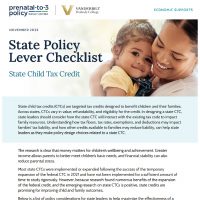
CTC Policy Lever Profile Thumbnail

State Policy Lever Checklist: State Child Tax Credit

Related

Mother holding baby close to her chest after delivery

New Research on Medicaid Work Requirements Highlights the Importance of State Policy Choices

As states implement new federal work requirements under OBBBA, several policy choices can help minimize unnecessary coverage loss.
Kids sitting in a classroom

New Vanderbilt Study Finds Nashville Child Care System Faces Interconnected Challenges in Supply, Workforce, and Affordability

As families across the country navigate the pressures of finding and affording child care, new research from Vanderbilt University’s Prenatal-to-3 Policy Impact Center examines what that landscape looks like in greater Nashville, Tennessee Nashville, Tennessee
Set of kid toys on a white shelf

Brief 5: Estimating the True Cost of High-Quality Home-Based Care – Insights from True-Cost Modeling

Home-based child care plays a small but vital role in greater Davidson County, Tennessee, offering families flexibility, affordability, and culturally aligned care, particularly for infants and toddlers. This brief uses a cost estimation model to examine the true cost of providing high-quality home-based child care in the region, where providers often serve simultaneously as educator, owner, and director.